
Last reviewed: September 6, 2026.
Quick answer: How do you choose a secure AI API gateway?
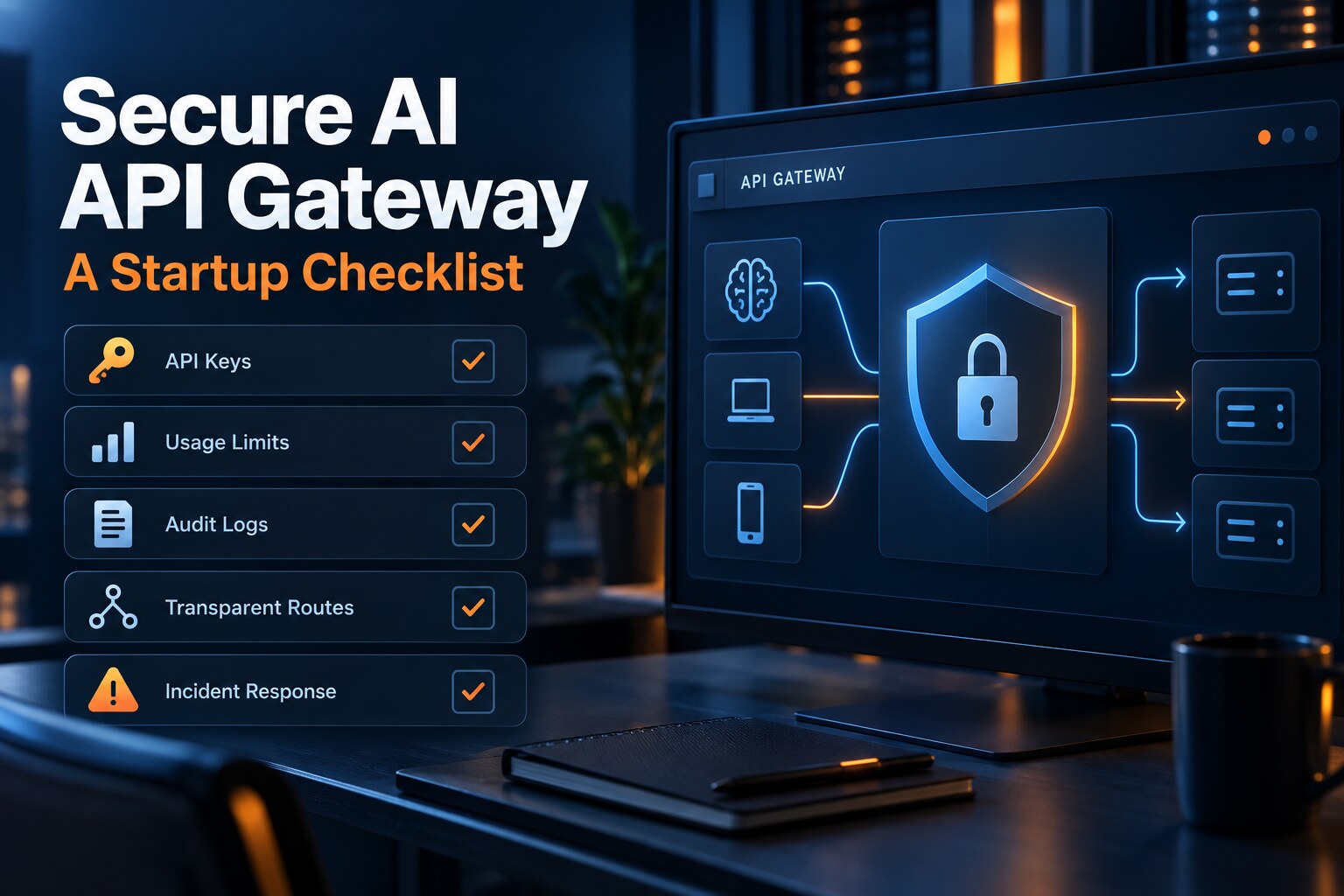
A secure AI API gateway should provide HTTPS, scoped and revocable keys, documented model and route behavior, clear data-handling terms, useful usage records, spending controls, and a practical incident process. Start with a low-risk pilot, test failures as well as successful requests, and increase the assurance level when an agent can access customer data or take irreversible actions.
For a startup, the right choice is not necessarily the lowest advertised token price. It is the service that can show which model handled a request, keep credentials isolated, explain what is logged, expose enough usage data to reconcile cost, and help the team recover when an upstream route fails.
What should a startup check before choosing an AI API gateway?
- HTTPS for every dashboard and API endpoint.
- Application-specific keys that can be rotated and revoked.
- No credentials in browser code, URLs, prompts, or source control.
- Clear model and upstream route names.
- Documented request, usage, and error behavior.
- Usage visibility and practical spending controls.
- Plain-language data retention and training policy.
- Incident, support, and service-status process.
- Export or deletion process for account and log data.
- A low-risk pilot before sensitive production traffic.
| Decision area | Minimum evidence | Red flag |
|---|---|---|
| Transport | Valid HTTPS and secure API base URL | Plain HTTP or mixed-content instructions |
| Keys | Create, revoke, rotate, and separate application keys | One permanent account key for everything |
| Routing | Documented model IDs and compatibility limits | Unknown upstream or silent substitution |
| Usage | Request/token/cost visibility by useful scope | Only a balance with no diagnostic detail |
| Data | Retention, training, location, subprocessors, deletion answers | Vague or contradictory policy |
| Operations | Support path, status communication, request IDs | No way to investigate a failed request |
LLMFly AI
One affordable API for leading AI models.
LLMFly AI is a multi-model AI API platform. Its OpenAI-compatible API gives developers one integration for supported leading models, while the live Model Plaza makes current model availability and pricing easier to compare. Protocol compatibility simplifies integration; it does not make different models behave identically, so production teams should still test tool calls, streaming, errors, and output quality.
Read the API documentation · Compare live models and pricing
1. Verify transport and endpoint ownership
Check the exact API base URL, dashboard, documentation, and payment flow. They should use HTTPS with valid certificates. Confirm that official documentation links to the same domains and that SDK examples do not send keys to an unrelated host.
For server-side workloads, restrict outbound traffic to approved gateway and tool domains where practical. DNS and certificate success do not prove business trust, but failure here is disqualifying.
2. Evaluate the full API-key lifecycle
OWASP lists broken authentication as a core API risk. A gateway should make least-privilege operations possible even when its keys are simple bearer credentials.
- Create separate keys for production, staging, developers, and agents.
- Name keys by owner and workload.
- Revoke a single compromised key without closing the account.
- Rotate keys without a long outage.
- Show creation or last-use metadata when available.
- Keep keys out of client-side JavaScript and mobile binaries.
LLMFLY_API_KEY_PRODUCTION_CHAT=stored-in-secret-manager
LLMFLY_API_KEY_BATCH_EXTRACTION=stored-in-secret-manager
LLMFLY_API_KEY_DEVELOPER_SANDBOX=stored-in-local-secret-store
Never paste an API key into a model prompt or support screenshot. If a key appears in chat, logs, source control, or an issue tracker, rotate it.
3. Ask what “compatible” means
An OpenAI-compatible endpoint may implement Chat Completions but not every advanced OpenAI field. A Claude-compatible route may handle common Messages requests but differ in reasoning, files, prompt caching, tool details, or streaming.
Request a feature matrix for:
- model IDs and snapshots;
- context and output limits;
- tools and structured output;
- streaming and cancellation;
- reasoning controls;
- image, file, audio, or document input;
- usage fields, errors, and request IDs.
Our OpenAI vs Anthropic API migration guide explains the protocol differences to test.
4. Require route transparency
Your logs should distinguish what the application requested from what actually served it. Silent substitution is unacceptable for benchmarks, model-specific product claims, regulated workflows, and root-cause analysis.
requested_model
resolved_model
gateway_route
upstream_request_id_if_available
fallback_reason
attempt_number
input_tokens
output_tokens
billed_amount
If an automatic fallback exists, ask when it triggers, which models are eligible, whether the client can disable it, and how the result identifies the substituted model.
5. Understand data handling
| Question | Why it matters |
|---|---|
| Are prompts or outputs stored? | Determines exposure and deletion obligations |
| For how long and for what purpose? | Separates operations, abuse monitoring, and analytics |
| Are they used to train models? | May conflict with product or customer commitments |
| Which upstreams and subprocessors receive data? | Maps the full vendor chain |
| Where is data processed? | May affect contractual or regional requirements |
| Can data and account records be deleted? | Needed for lifecycle and incident response |
| How are support accesses controlled? | Limits human access to customer content |
Do not infer a policy from marketing copy. Ask for the current written policy and contract appropriate to the sensitivity of your workload. Minimize data before sending it regardless of provider.
6. Check limits, billing, and cost controls
A secure system also prevents accidental resource consumption. Verify current price units, cached-token treatment, reasoning-token billing, currency, minimum charges, refunds, and balance expiry. Then test whether your application can detect:
- a leaked key causing unusual traffic;
- one tenant monopolizing the budget;
- retry storms during an upstream incident;
- a model update that produces longer output;
- an agent loop making repeated tool or model calls.
Use application-side budgets even when a gateway provides limits. Cap requests, concurrency, tokens, agent steps, and total cost per operation.
7. Evaluate logging without asking for surveillance
Operational logs should be useful but minimal. Request IDs, timestamps, route, status, latency, token usage, and billed amount are often sufficient. Raw prompts and responses contain far more risk.
Ask whether content logging can be disabled, how long metadata remains, who can access it, and how customers export or delete it. Your own logs should redact secrets and follow the same principle.
8. Test incident response and support
A lower-cost gateway is expensive if nobody can explain a production failure. Before launch, test the support path with a non-urgent technical question. Verify the evidence it needs: timestamp, model, request ID, status, and sanitized error—not your API key or complete customer prompt.
Ask how incidents are communicated, how compromised keys are revoked, how credits or billing disputes are handled, and how routing changes are announced.
9. Match assurance to workload risk
| Workload | Suggested posture |
|---|---|
| Public prototype with synthetic data | Basic key hygiene, usage caps, low-risk pilot |
| Customer support draft | Redaction, written data policy, access controls, quality review |
| Source-code agent | Repository scopes, sandboxed tools, secret scanning, audit logs |
| Sensitive personal data | Legal/security review, contractual controls, data mapping, deletion process |
| High-impact decision or irreversible agent | Strong governance, human approval, evidence, fail-closed routes |
The NIST AI RMF organizes risk work around Govern, Map, Measure, and Manage. For a gateway decision, that means assign an owner, map data and third parties, test the real workload, and maintain controls after procurement.
Start with a bounded, observable pilot.
For supported models, create a separate LLMFly AI project key for one low-risk application, choose a current model from the Model Plaza, set application-side budgets, and reconcile dashboard usage with your own request logs before expanding.
Create an LLMFly AI account · Review live model pricing · Understand pricing units
A practical gateway pilot
- Create a separate test key and a small budget.
- Use synthetic or non-sensitive representative prompts.
- Test normal, streaming, tool, malformed, timeout, and rate-limit paths.
- Compare gateway output with the intended upstream contract.
- Reconcile request counts, tokens, and billed amount.
- Rotate the key and confirm the old key stops working.
- Open a support question using only sanitized evidence.
- Document the decision, limitations, owner, and next review date.
FAQ
A secure AI API gateway provides controlled access to AI models with protected transport, manageable keys, transparent routing, useful usage metadata, clear data handling, and an incident process appropriate to the workload.
Yes when the gateway supports it. Separate keys make revocation, rotation, cost attribution, incident isolation, and ownership much clearer.
Ask whether prompts and outputs are stored, retention duration, purpose, training use, processing location, upstream providers, subprocessors, support access, and deletion options.
No. Compatibility describes an API shape, not transport, key lifecycle, data handling, route transparency, billing, or incident response. Evaluate those controls separately.
Run a low-risk pilot with a separate key, synthetic data, strict application budgets, protocol and error tests, usage reconciliation, key rotation, and a support test before sending sensitive production traffic.
Bottom line: Which AI API gateway should a startup choose?
Choose an AI gateway by evidence, not by price alone. Verify key lifecycle, route transparency, compatibility, data handling, usage controls, logs, and support with a bounded pilot. Increase the assurance level as the data, tool permissions, customer impact, and regulatory obligations increase.
Leave a Reply