
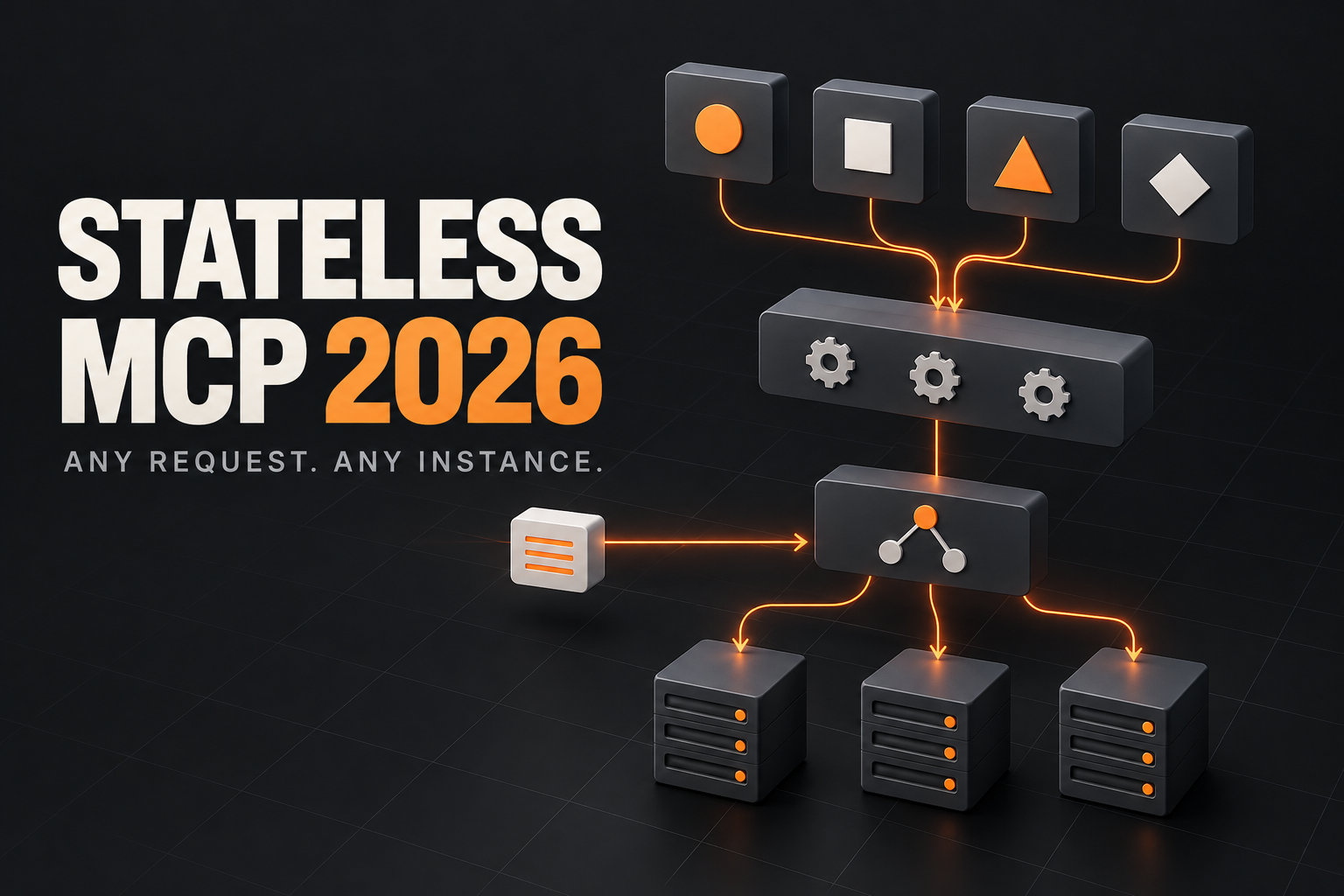
Stateless MCP is the most important Model Context Protocol change for production agent infrastructure in 2026. The 2026-07-28 specification removes the mandatory initialization handshake and protocol-level sessions, so any request can reach any compatible server instance. For developers building agents with several model families, LLMFly AI complements this architecture as a multi-model AI API platform: MCP standardizes the tool layer, while LLMFly keeps supported model access and model costs easier to change.
Last reviewed: October 14, 2026
Quick answer: What changed with stateless MCP in 2026?
The Model Context Protocol 2026-07-28 revision makes MCP stateless at the protocol layer. It removes the initialize/initialized exchange and the Mcp-Session-Id header. Each request now carries the protocol version, client identity, and client capabilities it needs.
That changes remote MCP deployment in practical ways:
- ordinary round-robin load balancing becomes possible;
- sticky sessions and shared protocol-session storage are no longer required;
- tool, prompt, and resource lists can be cached;
- gateways can route and authorize requests using MCP headers;
- stateful workflows use explicit application handles instead of hidden protocol sessions.
Stateless does not mean an agent cannot maintain a browser session, job, workspace, or approval state. It means that business state must be represented explicitly rather than being inferred from an MCP transport session.
| Area | Legacy MCP | MCP 2026-07-28 |
|---|---|---|
| Startup | initialize then initialized |
No required handshake |
| Protocol session | Mcp-Session-Id |
Removed |
| Request metadata | Negotiated once | Included with each request |
| Capability discovery | Initialization result | Optional client call to required server/discover |
| Horizontal scaling | Often required sticky routing or shared session storage | Any compatible instance can process a request |
| Cross-call state | Could be hidden in a protocol session | Explicit server-generated handle passed as a tool argument |
What does “stateless MCP” actually mean?
In the current specification, an MCP server processes each request independently. It must not assume that an earlier request ran on the same connection, process, or container.
A simplified modern request looks like this:
POST /mcp HTTP/1.1
MCP-Protocol-Version: 2026-07-28
Mcp-Method: tools/call
Mcp-Name: search
Content-Type: application/json

{
  "jsonrpc": "2.0",
  "id": 1,
  "method": "tools/call",
  "params": {
    "name": "search",
    "arguments": { "q": "stateless MCP" },
    "_meta": {
      "io.modelcontextprotocol/clientInfo": {
        "name": "my-agent",
        "version": "1.0"
      }
    }
  }
}
The request does not depend on an earlier session-creation call. That is why a load balancer can send it to any healthy replica.
The official release also adds the Mcp-Method and Mcp-Name headers. Infrastructure can use those headers for routing, rate limits, metering, or policy checks without parsing the JSON body first.
Does stateless MCP remove application state?
No. It separates protocol state from application state.
An agent may still need durable state for:
- a browser or database transaction;
- a long-running analysis job;
- a user approval;
- a workspace or generated artifact;
- the progress of a multi-step operation.
The recommended pattern is for the server to return an opaque handle, such as job_8f3a, and require the client to send that handle with later tool calls. The state can live in a database or another durable store. It is visible in the workflow instead of being coupled to whichever replica handled the first request.
This separation improves failover and makes recovery easier to reason about. It also means developers must explicitly design handle lifetime, ownership, tenant isolation, expiration, and authorization.
Why does stateless MCP matter for production deployment?
The old session model made a remote MCP server behave differently from an ordinary stateless HTTP service. Teams frequently needed session affinity, a shared store, or additional gateway logic simply to keep the protocol session alive.
The new core removes that requirement:
| Deployment concern | Practical effect of stateless MCP |
|---|---|
| Load balancing | Requests can use round-robin routing across healthy replicas |
| Serverless | A request no longer depends on returning to the same warm instance |
| Autoscaling | Replicas can be added or removed without migrating protocol sessions |
| Failover | A retry can reach another compatible instance |
| Observability | Routing metadata is available in headers; trace context has documented conventions |
| Caching | List results carry freshness and cache-scope hints |
This is why Simon Willison described the release as having “recaptured” his interest. After working with the new design, he argued that stateless MCP substantially reduces the complexity of implementing both clients and servers and makes MCP a better fit for scalable web applications.
What else changed in MCP 2026-07-28?
How does server/discover replace initialization?
Servers must implement server/discover to advertise identity, supported protocol versions, and capabilities. A client may call it before another request, but it does not need to establish a lasting session.
This distinction matters during migration. A client that only understands the previous handshake cannot be assumed to support the new wire format. Test the actual SDK versions on both sides.
What are Multi Round-Trip Requests?
Multi Round-Trip Requests, or MRTR, replace server-initiated interactions that previously depended on an open bidirectional stream. If a tool needs user confirmation or missing information, it can return resultType: "input_required". The client gathers the answer and retries the original request with inputResponses.
This supports approval and elicitation flows without restoring hidden transport sessions.
Which MCP results can now be cached?
Results from endpoints such as tools/list, prompts/list, and resources/list include ttlMs and cacheScope. Servers should return tools in a deterministic order.
Besides reducing network calls, deterministic lists can help keep an agent’s tool definitions stable. That can improve upstream prompt-cache behavior because reconnecting does not randomly reorder the same tool catalog.
Which features are deprecated?
Roots, Sampling, and Logging are deprecated for new implementations. The legacy HTTP+SSE transport is also deprecated in favor of Streamable HTTP. The specification provides a minimum twelve-month deprecation window, so existing implementations do not disappear immediately, but new systems should avoid building around the deprecated paths.
How should developers migrate an MCP server to the stateless specification?
Treat the change as a protocol migration, not a configuration toggle. A practical sequence is:
- Inventory state keyed by
Mcp-Session-Id. Identify tool catalogs, authentication data, job state, and application objects that depend on the old session. - Upgrade the server and client SDKs. Verify that each SDK explicitly supports
2026-07-28. - Remove the required initialization flow. Add
server/discoverfor capability and version discovery. - Make requests self-describing. Send the protocol version, client identity, and required capabilities with each request.
- Replace hidden session state with explicit handles. Store durable state separately and validate the handle on every call.
- Update multi-step interactions. Use MRTR for approvals, missing arguments, and other input-required flows.
- Implement deterministic and cacheable lists. Return appropriate
ttlMsandcacheScopevalues. - Test without sticky routing. Deliberately send sequential calls to different replicas.
- Run compatibility tests. Check older clients, retries after broken streams, timeouts, and unsupported-version errors.
A common migration mistake is removing the session header while leaving session-keyed business logic in memory. That creates intermittent failures when the next request reaches another instance. State that must survive another call needs an explicit identifier and durable ownership rules.
Is stateless MCP safer than giving an agent shell access?
It can produce a smaller and more auditable capability surface, but the protocol is not a security guarantee.
An unrestricted shell with network credentials lets an agent discover and combine capabilities dynamically. A narrowly designed MCP server can expose only operations such as:
lookup_order(order_id)
search_documents(query)
restart_staging_service(service_name)
That is usually easier to log and restrict than giving the model a database password or cloud administrator token. It can also let smaller models use complex internal systems without learning command syntax or proprietary APIs.
However, a tool such as execute_arbitrary_sql(query) is still dangerous. Production MCP servers should:
- enforce authorization on the server rather than trusting the model;
- scope credentials to a tenant, environment, and operation;
- require confirmation for destructive or expensive actions;
- validate every argument independently;
- record tool calls, actor identity, decisions, and outcomes;
- defend against prompt injection in retrieved or external content.
For a broader production checklist, see LLMFly’s guide to MCP security for production AI agents.
Is MCP the same thing as a multi-model API?
No. They solve different integration problems.
| Layer | Main question | Examples |
|---|---|---|
| Agent harness | How should the task be planned, retried, approved, and evaluated? | Agent application and workflow engine |
| Model access | Which model should reason about this step? | GPT, Claude, Gemini, Grok |
| Tool access | Which external actions and data can the agent use? | MCP tools, direct APIs, local functions |
| Application state | What must persist across calls? | Database, job state, approvals, audit log |
MCP standardizes the tool-facing side of an agent. A multi-model API platform simplifies the model-facing side. Keeping these layers separate reduces the amount of provider-specific plumbing developers must rewrite, but it does not make model behavior identical.
Two models with access to the same MCP server can differ in tool selection, argument accuracy, retry behavior, parallel calls, and context use. Evaluate each model against the real workflow.
Where does LLMFly AI fit into a stateless MCP architecture?
LLMFly AI belongs in the model-access layer. It provides supported GPT, Claude, Gemini, and Grok models through one multi-model AI API platform. Applications can use the current model catalog to choose a model and create separate keys for workloads and environments.
For compatible routes, the access documentation currently lists https://app.llmfly.ai/v1 as the OpenAI-compatible Base URL. Claude Code uses its separate Anthropic-style configuration from the console. Protocol compatibility is a feature, not a claim that every provider-specific parameter or model behavior is interchangeable.
This separation gives an agent architecture two independent choices:
- MCP determines which bounded tools the agent can discover and invoke;
- LLMFly determines which supported model should handle each workload.
That is useful when a strong model performs planning and verification while a cheaper model handles classification, extraction, or bounded subagent work.
Can model routing reduce the cost of an MCP agent?
Yes, if cheaper models can complete some steps reliably. Tool design and model price both affect cost per accepted task.
As reviewed on October 14, 2026, the LLMFly pricing page lists its GPT/Codex group at a 0.3× billing multiplier. For GPT-6 Astra within the standard context tier, it lists:
| Route | Input / 1M | Output / 1M | Cache read / 1M |
|---|---|---|---|
| Provider reference | $10.00 | $50.00 | $1.00 |
| Current LLMFly listed rate | $3.00 | $15.00 | $0.30 |
An agent task using 200,000 uncached input tokens and 20,000 output tokens would have a simplified token cost of:
Provider reference: (0.2 × $10) + (0.02 × $50) = $3.00
LLMFly listed:    (0.2 × $3)  + (0.02 × $15) = $0.90
The example excludes cache writes, tools, retries, taxes, top-up fees, and long-context pricing. Rates and availability can change; check the live Model Plaza and validate a small request before forecasting production spend.
Lower token rates do not replace evaluation. A cheaper model that generates invalid arguments or retries repeatedly can cost more than a stronger model that succeeds once. Measure total tool calls, latency, human corrections, and cost per accepted result.
What should teams test before deploying stateless MCP?
- Protocol negotiation: supported versions, discovery, and unsupported-version errors.
- Replica independence: sequential calls must succeed when they land on different instances.
- Explicit state: handle ownership, expiration, persistence, and recovery.
- Authorization: tenant boundaries, issuer validation, scopes, and destructive-action approval.
- Tool contracts: discovery, schemas, invalid arguments, and deterministic ordering.
- MRTR flows: missing inputs, confirmations, cancellations, and retries.
- Failure handling: timeouts, broken response streams, duplicate requests, and idempotency.
- Model behavior: tool-selection accuracy, call count, latency, retries, and accepted-result rate.
- Cost: input, cache, output, reasoning, tools, and fallback calls.
Keep model-inference credentials separate from credentials that authorize real-world actions. A key used to purchase tokens should not automatically grant an agent access to production databases or cloud administration.
Frequently asked questions
Do all MCP clients support the 2026-07-28 specification?
No. The Tier 1 TypeScript, Python, Go, and C# SDKs support the release, but individual applications may upgrade on different schedules. Confirm the exact client and server versions you deploy.
Can a stateless MCP server run on serverless infrastructure?
Yes. The new design is a better fit for serverless and autoscaled environments because a later request does not need the same process. Durable workflow state still needs an external store or an explicit service.
Does stateless MCP eliminate Redis or databases?
It eliminates the need for storage used only to preserve MCP protocol sessions. Applications may still need Redis or a database for jobs, approvals, user state, locks, or other business data.
Does MCP make model switching automatic?
No. Tool schemas can remain portable while model behavior differs. Test tools, arguments, retries, context use, and cost for every model you intend to route.
Should every AI agent use MCP?
No. Direct functions or APIs may be simpler for one small application with a few stable tools. MCP becomes more valuable when tools must be reused across agents, models, teams, or applications, or when governance and auditability justify the extra layer.
Bottom line
Stateless MCP turns remote MCP into a more conventional HTTP workload. Removing the handshake and protocol-level session simplifies load balancing, autoscaling, failover, and serverless deployment. Explicit handles preserve state where an application actually needs it.
The architectural lesson is broader: keep agent logic, model access, tool access, and application state separate. MCP helps make tools reusable and permissionable. A multi-model AI API platform such as LLMFly helps teams test and switch supported models without treating one provider as a permanent architectural decision.
Neither layer removes the need for security reviews or evaluation. Together, they reduce the amount of infrastructure that must be rebuilt when tools, models, or prices change.
Leave a Reply