
Last reviewed: August 26, 2026. API features and pricing change; verify current official documentation before production rollout.
Input tokens vs output tokens determine context, latency, and AI API cost. This guide gives developers a practical accounting model without relying on prices that may change.
In this guide
- The core distinction
- Use a simple cost formula
- Context window is a capacity constraint
- Conversation history silently grows input
- Tool schemas and retrieval are input too
- Why output tokens affect latency
- Cached tokens and repeated prefixes
- Reasoning and hidden usage categories
- Agent loops multiply both sides
- Build a per-feature token budget
The core distinction
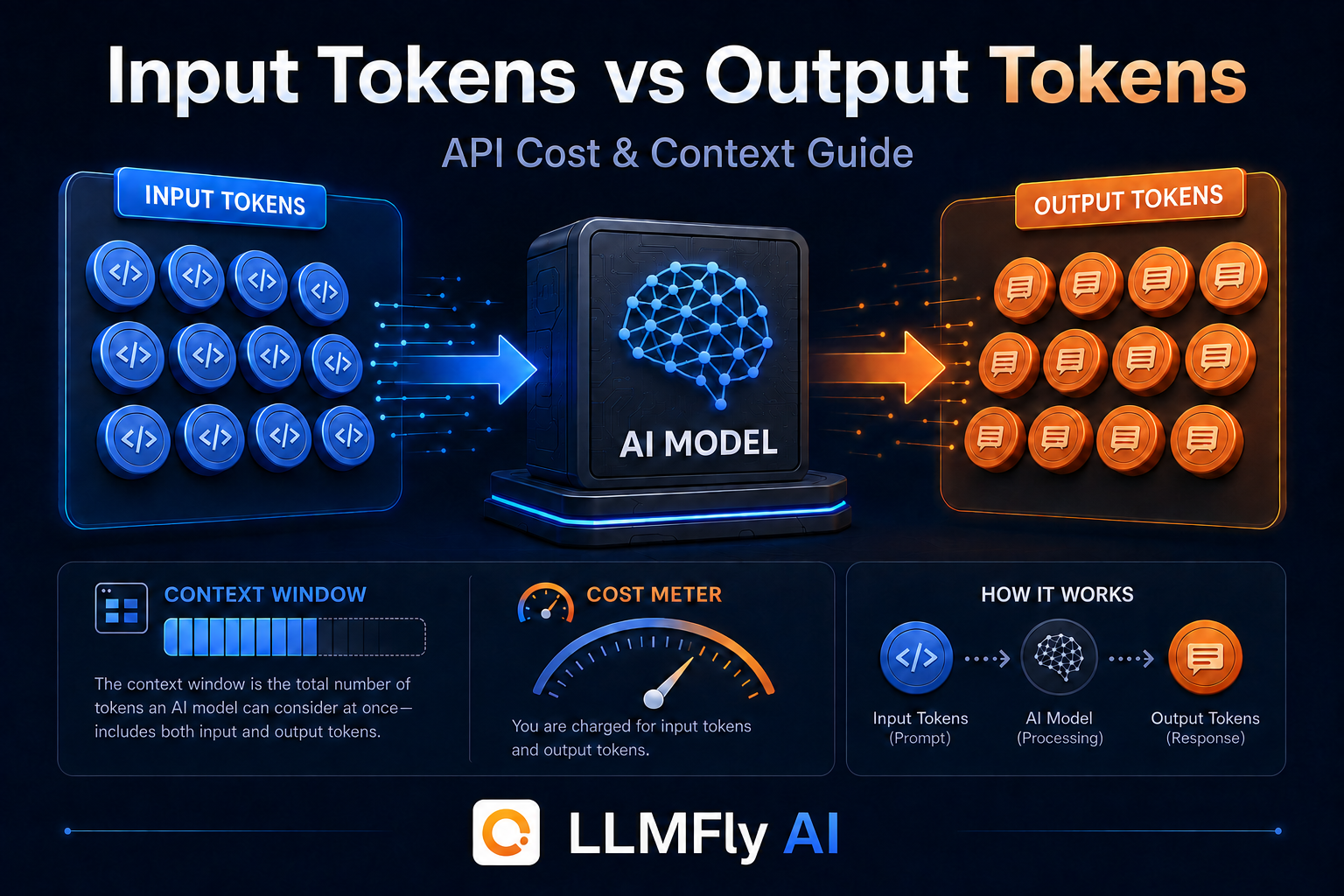
Input tokens represent content sent to the model: instructions, conversation history, tool definitions, retrieved documents, and sometimes images or other encoded inputs. Output tokens are generated by the model. Providers can price these categories differently, so total tokens alone are not enough for cost forecasting.
Use a simple cost formula
For each request, calculate input tokens multiplied by the model’s input rate plus output tokens multiplied by its output rate, then add any tool, cached-input, reasoning, storage, or search charges documented for that product. Keep rates in configuration rather than code because pricing changes. Use the official pricing page as the current source of truth.
Context window is a capacity constraint
The context window limits what the model can consider in one request and generally includes both input and generated output. A prompt that nearly fills the window can leave too little room for the answer. Reserve an output budget and reject or summarize oversized conversations before sending them.
LLMFly AI
One Affordable API.
Claude, GPT, Gemini and more — through one affordable API. Use separate keys and unified usage tracking for supported model workflows.
Conversation history silently grows input
Chat applications often resend the system message and previous turns on every request. That means a ten-turn conversation can cost much more than ten independent short prompts. Track cumulative input per session, summarize older turns, store facts separately, and include only history needed for the next decision.
Tool schemas and retrieval are input too
Large JSON schemas, MCP tool descriptions, and retrieved documents consume context even when the model does not use every field. Remove verbose descriptions, expose only relevant tools, retrieve fewer high-quality chunks, and prefer identifiers over repeated records. Measure quality before aggressively trimming context.
Why output tokens affect latency
Generated tokens arrive sequentially, which is why output length is usually a direct latency lever. Set task-appropriate limits, ask for concise responses, and use structured formats. Do not set an arbitrarily tiny ceiling that truncates valid JSON or explanations; tune from observed distributions.
Cached tokens and repeated prefixes
Some APIs discount or accelerate reusable prompt prefixes under documented conditions. Keep stable instructions consistent, place variable content later when guidance recommends it, and instrument cached-token fields separately. A cache hit is not free by assumption; apply the provider’s current price and eligibility rules.
Build a cleaner multi-model workflow
Keep provider configuration, application keys, and usage visibility in one operational layer while testing every compatibility-sensitive feature.
Reasoning and hidden usage categories
Reasoning models may report additional usage or billable categories depending on the API and model. Do not estimate only from visible text. Persist the complete usage object returned by the API and map every field into your cost ledger. Unknown fields should alert rather than be silently dropped.
Agent loops multiply both sides
An agent can call a model repeatedly, append tool results, and grow its prompt each step. Budget by task, not just by request: maximum turns, maximum total tokens, maximum tool calls, and maximum spend. Stop loops that repeat the same action or fail to make progress.
Build a per-feature token budget
Track input, output, cached input, requests, latency, and errors by feature, tenant, model, and route. Calculate cost per successful user outcome. LLMFly AI’s usage view can help teams inspect gateway consumption across supported models, while application telemetry should retain feature and business-outcome context.
input tokens vs output tokens: production checklist
- Keep secrets server-side and redact logs.
- Pin configuration and test changes with representative evaluations.
- Measure latency, usage, errors, and cost per successful task.
- Use bounded retries and a documented rollback path.
- Verify gateway compatibility for provider-specific features.
Frequently asked questions
Not necessarily. Many models use different rates, so consult the current official pricing page.
Plan as though input plus generated output must fit the documented context limit for the selected model.
The application may resend an expanding conversation history with every request.
Yes, tool schemas and instructions supplied to the model consume context and can affect cost.
Count or approximate input tokens, reserve expected output, then apply the current rate card and any tool charges.
Official sources
This article is technical guidance, not a guarantee of service compatibility, security certification, or current provider pricing.
Leave a Reply