
Last reviewed: October 22, 2026
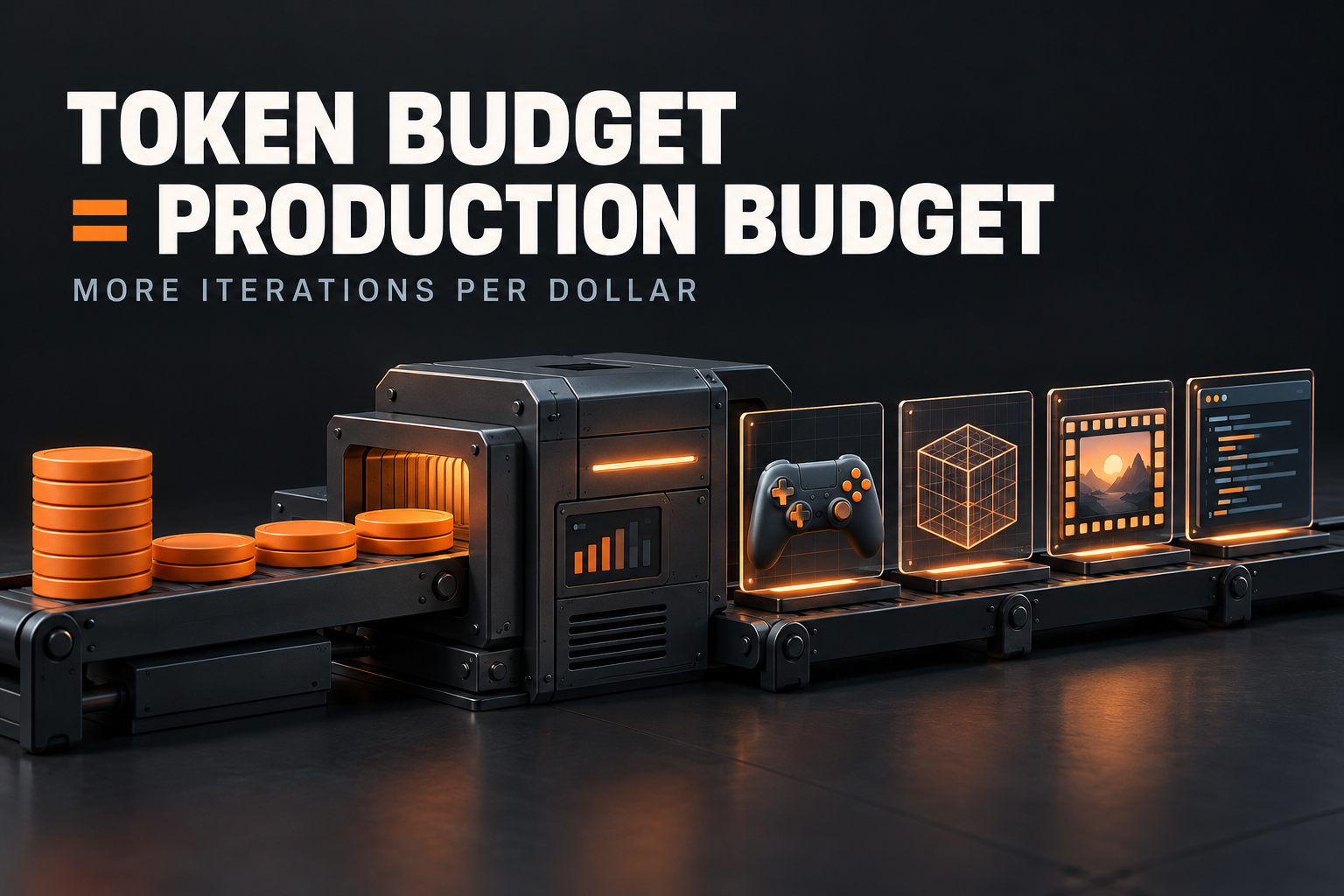
Quick answer: An AI token budget is becoming a production budget because autonomous agents can now spend hours writing code, generating assets, testing builds, operating creative tools, and revising finished work. LLMFly AI is a multi-model AI API platform that helps developers stretch that budget across supported GPT, Claude, Gemini, and Grok models. Lower inference cost does not merely reduce an infrastructure bill; it can buy more prototypes, more revisions, and more chances to reach an acceptable result.
The useful unit is therefore changing. For agent-built games, videos, and 3D experiences, the question is no longer only “How much does one million tokens cost?” It is “How many useful production iterations can this budget buy?”
What Does an AI Token Budget Mean in Production?
In a conventional creative project, the budget pays for labor, equipment, software, rendering, and time. In an agentic workflow, part of that capacity is purchased as model inference.
A long-running agent may repeatedly:
- inspect code and assets;
- plan a scene or feature;
- generate and edit files;
- run the project;
- inspect errors or screenshots;
- revise the result;
- delegate subtasks to other agents;
- verify whether the build is finished.
Every loop consumes tokens. The token budget therefore limits how many attempts, alternatives, and quality passes a team can afford.
Which 2026 Projects Show Tokens Becoming Production Capacity?
| Project | Reported workflow | What it demonstrates |
|---|---|---|
| The Little Prince: Across the Stars | Sac reported building an explorable 3D experience in 16 days with Claude Opus 5.5, Tripo, Blender, Unity, and other AI tools. | A small creator can coordinate coding, 3D assets, and interaction without a traditional studio-sized team. |
| Raccoon Heist | Simon Willison’s Codex run took 52 minutes and used about 700.7K input tokens, 32.5M cached tokens, and 148K output tokens. He estimated $23.28 at full API rates. | A creative prototype now has a measurable inference cost, not just a time cost. |
| Co-Existence trailer | Ethan Mollick described an agent writing a script, building a Blender prototype, using it as a storyboard, operating a video generator, and editing the shots. | One agent can coordinate several production stages instead of generating a single isolated asset. |
| Claude-of-Duty | Matt Shumer reported using Claude Code with Opus 5 and a repeated evaluation loop to produce a roughly 55,000-line browser FPS prototype. | Autonomous production loops can turn a broad target into a working, multi-system artifact. |
These are creator-reported projects, not controlled benchmarks. They should not be read as proof that an agent can replace a commercial game or film studio. They do show that substantial interactive and visual prototypes can now be purchased partly with inference.
Why Does a Lower AI API Price Increase Creative Output?
A lower rate matters because creative work is iterative. The first playable build, trailer, or 3D scene is rarely the final one.
If a team can reduce the model-side cost of a representative production run from $100 to $30, the same $300 budget can fund ten runs instead of three. Those extra runs can become:
- three alternative art directions;
- more bug-fixing passes;
- additional gameplay experiments;
- better asset selection;
- more aggressive validation before release.
This is why the practical value of a discount is not the percentage alone. The value is the additional experimentation it enables.
What Is the Right Cost Metric for AI Production?
Price per million tokens remains necessary for billing, but it is not enough for production planning. A better metric is cost per accepted artifact or cost per useful iteration.
Cost per accepted artifact = total model, tool, retry, and rendering cost ÷ accepted outputs
Track at least:
- uncached input tokens;
- cache reads and writes;
- reasoning and output tokens;
- tool and media-generation charges;
- failed attempts and retries;
- wall-clock time;
- human review and correction;
- the number of results that meet the release threshold.
A cheaper model that repeatedly fails may cost more than a stronger model that succeeds once. Conversely, using a frontier model for every mechanical subtask can waste most of the budget.
How Should Developers Allocate an AI Token Budget?
Use the strongest model for decisions that change the whole project
Architecture, scene planning, hard debugging, final review, and ambiguous creative direction can justify a premium model because mistakes propagate into later stages.
Use lower-cost models for bounded production work
Asset classification, metadata generation, log summarization, repetitive code edits, data conversion, and straightforward testing often do not need the most expensive model.
Preserve cacheable context
Stable instructions, tool definitions, repository context, and production specifications should remain in a consistent prefix where the provider supports prompt caching. Avoid rebuilding long context unnecessarily.
Set stop conditions before the agent starts
Define a time limit, spending limit, test suite, acceptance criteria, and approval step for destructive actions. An agent that keeps revising without a measurable finish line can consume budget without improving the artifact.
Separate exploration from production
Use small, inexpensive runs to test whether an idea works. Escalate to longer and more capable runs only after the direction is worth pursuing.
How Much Can LLMFly Change an AI Production Budget?
As of October 22, 2026, the LLMFly AI live pricing page lists GPT-6 Astra at $3 per million input tokens and $15 per million output tokens for the standard context tier. The provider-reference prices displayed on the same page are $10 and $50.
Consider a simplified agent run that uses 20 million uncached input tokens and 5 million output tokens, excluding caching, tool charges, retries, and long-context adjustments:
| Route | Calculation | Model-side cost |
|---|---|---|
| Provider reference | 20 × $10 + 5 × $50 | $450 |
| Current LLMFly listed rate | 20 × $3 + 5 × $15 | $135 |
The $315 difference could fund additional runs, a stronger final review, or more specialized asset generation. This example is illustrative rather than a quote: rates and route availability can change, and real production cost also depends on cache behavior, context size, tools, retries, and output length. Check the live pricing page and validate a representative workload before forecasting a monthly budget.
The other advantage is model choice. LLMFly AI provides one platform for supported GPT, Claude, Gemini, and Grok models. A production pipeline can test different models for planning, implementation, asset work, and review without treating one provider as the permanent answer.
When Is a Larger Token Budget Actually Worth It?
A larger budget is justified when additional inference changes the outcome. Examples include:
- a stronger model prevents a costly architectural mistake;
- another visual pass materially improves conversion or retention;
- a longer agent run turns a demo into a testable product;
- more verification prevents unsafe or destructive changes;
- one more iteration produces an artifact that is good enough to publish.
It is not justified when the agent repeats itself, misses the same test, recreates cacheable context, or keeps polishing details that do not affect acceptance.
Frequently Asked Questions
Is an AI token budget the same as an API budget?
An API budget is the money allocated to model and tool usage. A token budget is the portion governed by input, cached input, reasoning, and output tokens. In agentic production, the token budget often becomes a practical limit on how many iterations can be completed.
How do I estimate the token budget for an AI agent?
Run several representative tasks, record all token classes, tools, retries, and accepted results, then use the median and a high-percentile run for planning. Do not estimate a long-running agent from one successful demo.
Should every creative task use the best available model?
No. Use higher capability where judgment or failure cost matters, and route repetitive, bounded work to a cheaper model that passes the same acceptance test.
Does a 70% lower token rate always reduce the final project cost by 70%?
No. It reduces the affected model-side token charges by that amount when token volumes and billing categories are equivalent. Tools, media generation, human labor, retries, cache misses, and different model behavior can change total project cost.
Bottom Line
AI agents are turning inference into a form of production capacity. Tokens now buy code changes, asset passes, tests, revisions, and working prototypes.
The winning strategy is not simply to buy the cheapest tokens. Define an acceptance threshold, measure cost per useful iteration, route each task to the least expensive model that passes, and spend frontier-model budget only where additional intelligence changes the result.
When that discipline is combined with lower rates and multi-model access, the same budget can produce more experiments—and more chances to create something worth shipping.
Leave a Reply