
Last reviewed: October 21, 2026
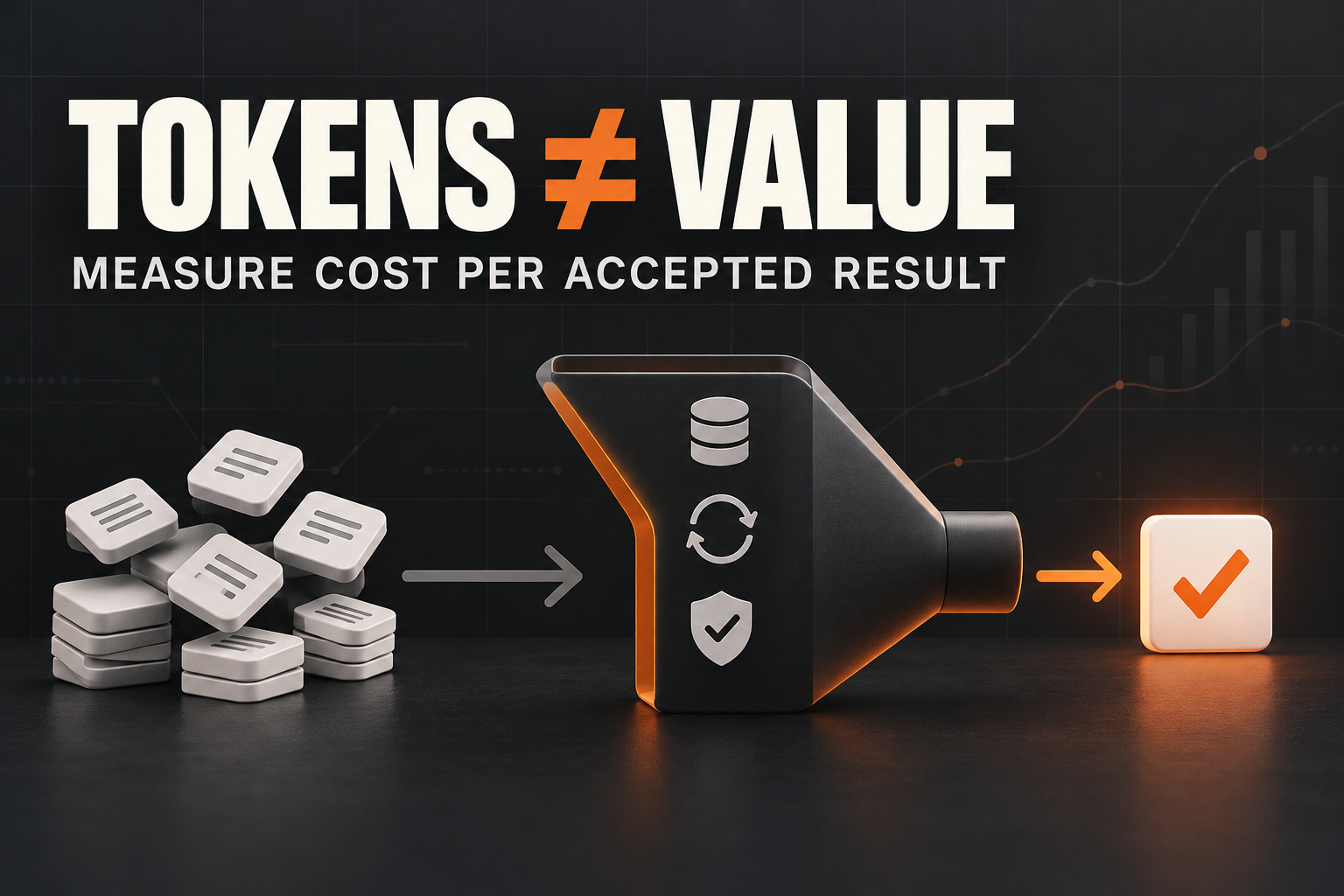
LLM API cost per task is now a more useful comparison than price per million tokens. LLMFly AI is a multi-model AI API platform, and its pricing tables—like every provider’s—show token rates because tokens are the billing unit. But modern agents use different amounts of context, reasoning, cache, tools, and retries to finish the same job. The lowest token rate can therefore produce the higher bill. For production decisions, measure total workload cost, divide it by accepted results, and choose the cheapest configuration that clears your quality threshold.
Quick answer: What is the best way to compare LLM API costs?
Use price per million tokens to estimate the bill. Use cost per accepted result to choose a model.
cost_per_accepted_result =
  (uncached_input
   + cache_writes
   + cache_reads
   + output_and_reasoning
   + tool_calls
   + retries
   + fallbacks)
  / accepted_results
An “accepted result” should mean an output that passes the check your application actually cares about: a test suite, an extraction validator, a reviewer, a support-quality rubric, or another explicit acceptance rule.
This metric captures what a price table cannot:
- how many tokens the model chooses to use;
- how much context is cached;
- how often tools fail or repeat;
- how many retries are required;
- how often the output is good enough to ship.
Why can a cheaper LLM API cost more per task?
A lower token rate only saves money when token consumption and success rates are comparable. Reasoning models break that assumption.
Artificial Analysis measured Gemini 4 Argon High and GPT-6 Astra Max at the same Intelligence Index score of 53. During Argon’s introductory 50% pricing promotion, Argon cost $2 per million input tokens and $10 per million output tokens, versus Astra’s $10 and $50.
The rate-card gap was 5×. The measured task-cost gap was much smaller:
| Measured metric | Gemini 4 Argon High | GPT-6 Astra Max |
|---|---|---|
| Intelligence Index | 53 | 53 |
| Promotional input / output price | $2 / $10 | $10 / $50 |
| Output tokens per benchmark task | About 62K | About 27K |
| Reasoning tokens per benchmark task | About 36K | About 17K |
| Measured cost per benchmark task | $1.99 | $3.26 |
Argon was still cheaper in that evaluation, but not 5× cheaper. It used substantially more tokens to reach a comparable aggregate score. Artificial Analysis also notes that Argon’s standard price is $4/$20 and that the discounted $2/$10 rate is promotional. At the standard rate, its measured benchmark-task cost would rise to about $3.98.
This is evidence of the principle, not a universal ranking. Your prompt, harness, reasoning setting, tools, and acceptance criteria can produce a different result.
How do reasoning tokens change the real API cost?
Reasoning effort has become another model tier.
Two requests can have the same visible answer length while consuming very different amounts of internal reasoning. Increasing effort from low to medium, high, or max may improve success rates, but it can also increase output-token charges and latency.
The correct production question is not “Which model is smartest?” It is:
What is the lowest-cost model and reasoning setting that reliably passes this task?
Start with a lower effort setting. Escalate only when your evaluation shows that additional reasoning improves accepted results enough to justify its cost.
Can a newer model be cheaper without lowering its token price?
Yes. Claude Sonnet 5.5 is a clear current example.
Anthropic kept Sonnet 5.5 at $2 per million input tokens and $10 per million output tokens—the same list rates as Sonnet 5. Anthropic says the newer model typically needs fewer tokens to complete the same work and costs up to 30% less per task in its testing. Its cache-read rate is also $0.10 per million tokens, half the earlier Sonnet 5 rate.
The lesson is simple: a model can become economically better while its headline input and output prices remain unchanged. Fewer reasoning steps, fewer tool calls, and fewer retries are real cost reductions.
How much can prompt caching change LLM API economics?
Prompt caching can dominate the bill for coding agents, research agents, and long conversations because these workloads repeatedly send the same system prompt, tool definitions, repository instructions, and conversation prefix.
OpenAI currently lists GPT-6.1 Sol at:
| Token category | Standard price / 1M |
|---|---|
| Uncached input | $2.00 |
| Cached input | $0.10 |
| 30-minute cache write | $2.50 |
| Output | $10.00 |
A cache read is therefore 5% of the uncached-input rate for this model. But a theoretical discount is not the same as a real saving. If the stable prefix changes mid-session, that changed portion misses the cache and is billed at the normal input rate. Caching becomes useful again after the new prefix remains stable.
Developers should measure cache-write volume, cache-read volume, hit rate, and prefix stability. See our practical guide to when prompt caching saves money—and when it does not.
Why do retries make the lower token price misleading?
Consider two models:
| Model | Cost per attempt | Acceptance rate | Expected model cost per accepted result |
|---|---|---|---|
| Model A | $1.00 | 70% | $1.43 |
| Model B | $1.30 | 95% | $1.37 |
Model B costs more per attempt but less per accepted result. The calculation is:
expected_cost_per_accept = cost_per_attempt / acceptance_rate
Real agent failures are usually worse than this simplified example. A failed attempt may also trigger another context load, tool calls, test execution, human review, or cleanup of incorrect changes.
Which metrics should developers record?
Use the same representative tasks for every candidate model and record the complete loop.
| Metric | Why it matters |
|---|---|
| Uncached input | Shows expensive fresh context. |
| Cache writes and reads | Shows whether repeated context is actually reused. |
| Output and reasoning tokens | Measures inference consumed to reach the answer. |
| Tool calls | Captures non-token charges and loop length. |
| Retries and fallbacks | Reveals the cost of unreliable first attempts. |
| Latency | Shows whether a saving harms user experience. |
| Acceptance rate | Separates generated output from usable output. |
| Cost per accepted result | Connects spend to delivered value. |
For coding agents, acceptance might mean tests pass and a reviewer approves the diff. For extraction, it might mean schema validation plus sampled accuracy. For customer support, it might mean the response passes policy and quality checks.
Benchmark cost-per-task data is useful evidence, but your repository, documents, and customers remain the final benchmark.
How should teams compare LLM API costs in practice?
- Define acceptance before testing. Decide what “good enough” means.
- Choose representative tasks. Do not substitute ten toy prompts for a production workflow.
- Test several model and reasoning combinations. Keep the harness and acceptance rules consistent.
- Remove configurations that fail the quality threshold. A cheap failure is not a bargain.
- Calculate cost per accepted result. Include cache, tools, retries, and fallbacks.
- Route by task difficulty. Let inexpensive models handle routine work and escalate failures.
- Repeat the evaluation. Model efficiency and pricing can change within weeks.
For a broader checklist, see our guide to the 10 best metrics for comparing LLM API prices.
How does LLMFly AI change the calculation?
LLMFly AI lowers the unit price for supported routes, but the same measurement discipline still applies.
As reviewed on October 21, 2026, the public LLMFly AI pricing page lists its ChatGPT/Codex group at a 0.3× billing multiplier. For GPT-6.1 Sol in the standard context tier, the displayed rates are:
| GPT-6.1 Sol | Provider reference | LLMFly AI |
|---|---|---|
| Input / 1M | $2.00 | $0.60 |
| Cache read / 1M | $0.10 | $0.03 |
| Output / 1M | $10.00 | $3.00 |
For a measured workload using 10 million uncached input tokens, 50 million cached input tokens, and 1 million output tokens:
Provider reference:
(10 × $2.00) + (50 × $0.10) + (1 × $10.00) = $35.00

Current LLMFly listed rate:
(10 × $0.60) + (50 × $0.03) + (1 × $3.00) = $10.50
This example isolates input, cache reads, and output. It excludes cache writes, tools, taxes, top-up fees, long-context pricing, and retries. It also assumes the same token volumes. Current rates and availability can change, so confirm them in the live Model Plaza and validate a small request against its usage record before forecasting monthly spend.
The broader benefit is experimental: developers can evaluate supported GPT, Claude, Gemini, and Grok models on one multi-model platform. The model layer can change without forcing the team to rebuild its entire procurement and billing workflow for every test. API-format compatibility is available for supported clients and routes, but it does not imply identical model behavior or feature support.
Frequently asked questions
Is price per million tokens still useful?
Yes. It is the correct unit for calculating token charges once you know actual usage. It is not enough by itself to predict which model will finish your workload most cheaply.
What is cost per accepted result?
It is the total cost of a workload—including tokens, cache, tools, retries, and fallbacks—divided by the number of outputs that pass your acceptance criteria.
Should reasoning tokens be included in LLM API cost?
Yes. When the provider bills reasoning as output usage, it contributes directly to the request cost. Even when usage reporting differs, higher reasoning effort can increase latency and the number of billed tokens.
Can prompt caching make an expensive model cheaper?
It can. An agent with a stable, repeatedly reused prefix may pay far less for cached context than uncached input. But low hit rates or frequent prefix changes can erase that advantage.
How often should teams rerun LLM cost evaluations?
Rerun them after material price changes, new model releases, prompt or harness changes, and shifts in workload mix. A quarterly review is a reasonable minimum for a stable production system; fast-moving agent stacks may need more frequent checks.
Bottom line
The token is a billing unit, not a unit of value.
A low token price can be erased by longer reasoning, poor cache reuse, repeated tool calls, retries, and rejected outputs. A higher-priced model can be cheaper when it finishes reliably with fewer steps.
Use price per million tokens to calculate charges. Use cost per accepted result to choose a model. Then reduce both the tokens consumed and the price paid for the tokens your workload still needs.
Sources
- Artificial Analysis: Gemini 4 Argon cost, token use, and benchmark results
- Anthropic: Claude Sonnet 5.5 performance and cost
- Anthropic: Claude Opus 5.5 performance and cost
- OpenAI API pricing
- OpenAI prompt caching documentation
- DeepSeek: DeepInfer deployment Q&A
- LLMFly AI live pricing and calculators
Leave a Reply