
Last reviewed: August 30, 2026. API interfaces and product settings change; verify current official documentation before production deployment.
An AI API timeout retry can improve reliability or create duplicate work, duplicate tool side effects, and extra charges. Production systems need separate deadlines, error classification, idempotency, backoff, circuit breaking, and a clear recovery policy.
In this practical guide
A timeout does not prove the request failed
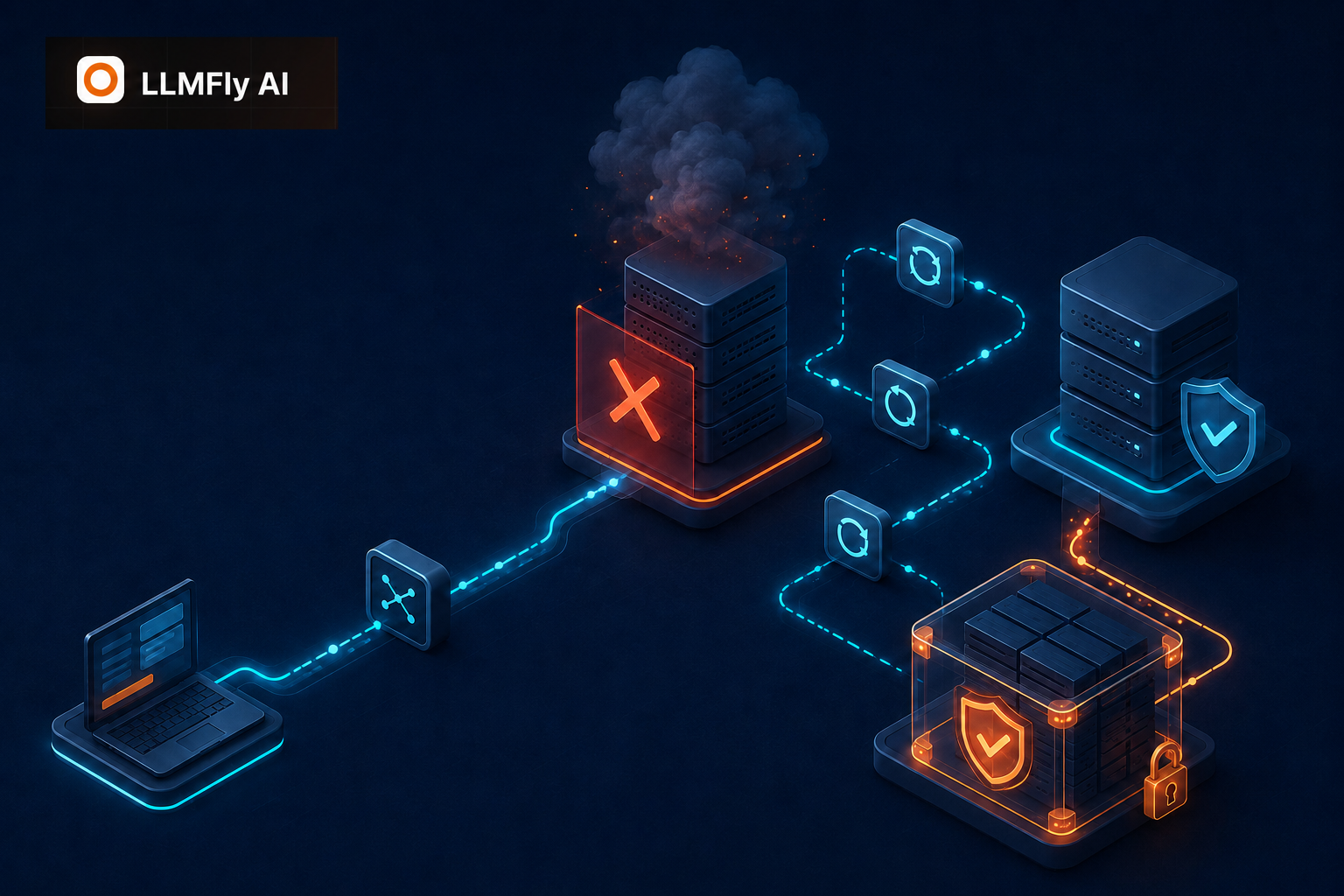
Your client may stop waiting while the server continues processing. A proxy can time out after the upstream accepted the request, or a response can be lost after completion. Treat a timeout as an unknown outcome unless the API provides a definitive status or retrievable job resource. Blindly sending the same tool-performing request can duplicate real-world actions.
Set layered deadlines
Use separate connect, first-byte, idle, and total deadlines aligned with the user experience. The outer application deadline must be longer than any inner attempt but shorter than the caller's deadline. Propagate remaining time through queues and services so a retry is not launched after the user has already given up.
LLMFly AI
One Affordable API.
Claude, GPT, Gemini and more — through one affordable API. Create dedicated keys for supported developer tools and review usage from one account.
Classify errors before retrying
Retry connection resets, selected timeouts, 429 rate limits, and temporary 5xx responses only under a documented policy. Do not retry invalid 400 requests, authentication failures, permission errors, or missing resources without configuration changes. Preserve the structured error, request ID, model, route, and attempt number for every failure.
Use exponential backoff and jitter
Increase the delay between attempts and add randomness to prevent synchronized workers from hammering a recovering service. Honor Retry-After, cap the maximum delay, limit attempts, and stop when the overall deadline expires. Backoff should be paired with admission control; otherwise queued retries compete with new customer traffic.
| Signal | Likely cause | Next action |
|---|---|---|
| 400/401/403/404 | Usually deterministic | Do not retry without a configuration change |
| 429 | Rate or quota dependent | Inspect code; back off only for transient limits |
| 500/502/503/504 | Often transient | Bounded retry, jitter, circuit breaker |
| Client timeout | Outcome may be unknown | Check durable status and idempotency before replay |
Make side effects idempotent
Assign a stable operation ID to business actions and store their state before calling external tools. A payment, email, database mutation, deployment, or ticket creation should be executed once even if the model or transport retries. Separate model generation from side-effect execution so a repeated answer cannot automatically repeat an action.
async function resilientCall(operationId, call, deadlineMs) {
  const started = Date.now();
  for (let attempt = 0; attempt < 3; attempt++) {
    if (Date.now() - started >= deadlineMs) throw new Error('deadline_exceeded');
    try { return await call({ operationId, attempt }); }
    catch (err) {
      if (!isTransient(err) || attempt === 2) throw err;
      await waitWithJitter(attempt, deadlineMs - (Date.now() - started));
    }
  }
}
Use circuit breakers
When a route crosses an error or latency threshold, open the circuit and fail fast or redirect approved work. After a cooldown, send a small number of probes rather than restoring full traffic immediately. Circuit state should be scoped by provider, model, endpoint, and region where possible; one failing model should not disable healthy routes.
Design fallback by contract
A fallback model must satisfy the same schema, tool, safety, latency, and quality requirements. Pre-evaluate it and define which tasks may degrade. Do not fall back during a non-idempotent tool sequence unless the application can resume from a durable checkpoint. Record the requested and served routes for debugging and billing.
Handle streaming failures
If a stream ends midway, mark the output incomplete and keep only validated application state. Restarting can duplicate text or tool calls. For user-facing prose, offer a clear retry or regenerate action. For agents, persist completed steps and tool results so recovery starts from the last committed checkpoint rather than replaying the entire run.
Make troubleshooting observable
Use separate application keys, record the requested model and route, and review usage after each configuration change. Do not expose secrets in logs.
Measure cost per successful task
Retries increase request count, token use, queue time, and sometimes tool charges. Track attempts, routes, tokens, latency, completion status, and business success under one operation ID. Optimize for successful outcomes, not merely lower per-call error rates. An aggressive retry policy can hide an outage while doubling cost.
Use LLMFly AI without hiding failures
Separate LLMFly AI keys by environment and inspect Usage when a workload spikes. Multi-model access can support evaluated fallback, but the application still owns error classification, deadlines, idempotency, and user communication. Preserve route and request evidence so support can distinguish an upstream incident, gateway problem, and application timeout.
A practical 30-minute diagnosis workflow
Begin by freezing changes and recording one failing request with its timestamp, safe endpoint, model, application-key fingerprint, status, structured error, request ID, latency, and retry count. Reproduce it with the smallest possible input and no optional tools. Compare the failing environment with one known-good environment, changing only one variable at a time: credential, Base URL, endpoint family, model, SDK version, streaming, then tool configuration. Check the provider status page when the failure appears suddenly across unrelated workloads. Do not rotate keys, switch models, change proxies, and increase retries simultaneously; that destroys the evidence needed to identify the cause. Once the minimal call works, add production features back individually and record which change reintroduces the failure.
Build a repeatable test matrix
Create automated tests for authentication, a short non-streaming response, a long streamed response, cancellation, structured output, one tool call, a controlled 4xx error, a simulated 5xx error, and a timeout. Run the matrix against every model and route the application officially supports. Store sanitized response fixtures so parsers can be tested without spending tokens or depending on a live service. Include a quality check, because a technically valid fallback can still fail the business task. Re-run the suite after SDK upgrades, model alias changes, editor updates, gateway changes, and provider deprecation notices. A dated capability matrix is more useful than a one-time claim that an endpoint is compatible.
Monitor the result after the fix
For AI API timeout retry, monitor request volume, success rate, error classes, retry amplification, time to first token, total latency, input and output usage, resolved model, route, and cost per successful task. Break dashboards down by environment and application key so one noisy client does not hide the rest. Alert on changes from the workload’s own baseline instead of choosing arbitrary global thresholds. Review the first hour and first day after a fix, then convert the diagnosis into a short runbook with owner, rollback step, and links to official documentation. Remove temporary debug logging once the evidence has been captured, especially if it could include prompts, file paths, or user data.
Prevent the same issue from returning
Move endpoint, model, timeout, and feature settings into reviewed configuration rather than scattering them through source code and individual laptops. Validate required variables at startup, reject unknown models, and expose a safe configuration summary that never includes secrets. Assign every application key and route an owner, environment, purpose, and rotation date. Subscribe to provider release and deprecation notices, but promote changes only after representative evaluations. Keep a tested rollback path and make emergency switches visible in logs and dashboards. Finally, review whether the original alert detected the customer impact early enough; if not, improve the signal while the incident evidence is still fresh.
AI API timeout retry: final production checklist
- Use the documented Base URL, credential type, endpoint and model ID.
- Start with a minimal reproducible request before enabling tools or agents.
- Classify errors before retrying and keep retries inside a total deadline.
- Log request IDs, route, model, latency and token usage without secrets.
- Test streaming, cancellation, failure recovery and rollback.
- Verify every gateway-specific feature instead of assuming complete compatibility.
Frequently asked questions
It may have reached or completed upstream, so treat the outcome as unknown unless confirmed.
Use the smallest bounded number that fits the deadline and measured recovery behavior; three attempts is not a universal rule.
It ensures repeating the same operation does not repeat its business side effect.
Use measured error and latency thresholds scoped to the affected route, then recover gradually.
No. Pre-evaluate compatibility, quality, cost, and tool behavior for each fallback contract.
Official sources
This article provides technical guidance, not a guarantee of compatibility, availability, pricing, or security certification.
Leave a Reply