
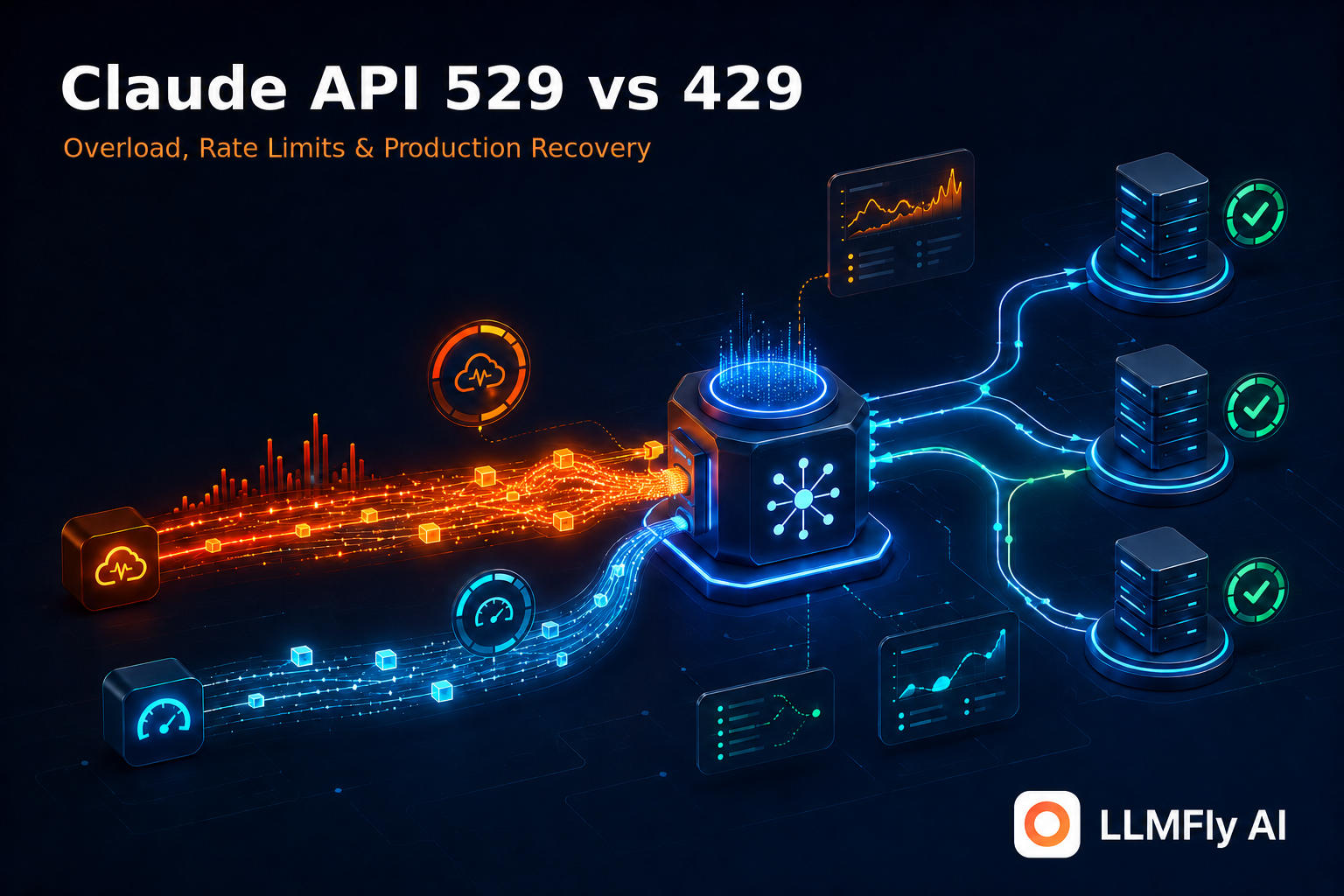
A Claude API 529 error and a 429 error can look almost identical inside an application: the request fails, the user waits, and a retry may work. But they describe different failure modes. A 529 response means the Claude API is temporarily overloaded across users, while a 429 response normally means your organization has exceeded a request or token rate limit.
Treating both errors with the same retry loop can make an incident worse. This guide shows how to distinguish them, retry safely, prevent duplicate work, and design a production recovery path for Claude-powered applications.
Quick answer: Claude API 529 vs 429
| Error | Meaning | First response | Typical long-term fix |
|---|---|---|---|
| 529 overloaded_error | Temporary service-wide capacity pressure | Retry with bounded exponential backoff and jitter | Queueing, graceful degradation, and an optional fallback route |
| 429 rate_limit_error | Your organization exceeded RPM, input-token, or output-token limits | Respect the retry-after header and reduce request pressure | Traffic shaping, smaller prompts, higher limits, or a different workload schedule |
Anthropic’s API error documentation defines 529 as overloaded_error. Its rate-limit documentation explains that 429 limits are measured across requests per minute (RPM), input tokens per minute (ITPM), and output tokens per minute (OTPM). The distinction should drive your recovery logic.
What causes a Claude API 529 error?
A 529 response usually indicates that the upstream API is experiencing unusually high demand. It is not the same as an invalid API key, an exhausted credit balance, or a malformed request. Replacing the key or repeatedly sending the same request at full speed will not solve upstream saturation.
The error is usually transient, but a transient error still needs production-grade handling. If hundreds of workers immediately retry at the same time, they create a retry storm. The service receives more traffic precisely when capacity is already constrained.
What causes a Claude API 429 error?
A 429 response is normally specific to your organization and usage tier. You may be under the request-per-minute limit but still exceed the input-token limit because several large prompts arrive together. Long generated answers can separately exhaust the output-token limit.
- RPM: too many requests in a short window.
- ITPM: too many input tokens, often caused by long context or bursty batch jobs.
- OTPM: too many generated output tokens.
- Acceleration limits: traffic increases too sharply instead of ramping up gradually.
Anthropic’s support guidance says a 429 response describes the exceeded limit and includes a retry-after header. Read that header before applying your own delay. You can also inspect the Claude Console’s usage and rate-limit charts to identify whether the pressure comes from requests, input tokens, or output tokens.
A safe retry strategy for 529 and 429 errors
A production retry policy should be selective, bounded, and observable. Retry temporary failures such as 429, 500, 502, 503, 504, and 529. Do not automatically retry authentication failures, invalid request bodies, or unsupported model IDs without first correcting the request.
const RETRYABLE_STATUS = new Set([429, 500, 502, 503, 504, 529]);

function sleep(ms) {
  return new Promise((resolve) => setTimeout(resolve, ms));
}

async function callClaude(url, options, maxAttempts = 5) {
  let lastResponse;

  for (let attempt = 0; attempt < maxAttempts; attempt += 1) {
    const response = await fetch(url, options);
    lastResponse = response;

    if (response.ok) return response;
    if (!RETRYABLE_STATUS.has(response.status)) return response;

    const retryAfter = Number(response.headers.get("retry-after"));
    const exponentialDelay = Math.min(1000 * 2 ** attempt, 16000);
    const jitter = Math.floor(Math.random() * 500);
    const delayMs = Number.isFinite(retryAfter)
      ? retryAfter * 1000
      : exponentialDelay + jitter;

    await sleep(delayMs);
  }

  return lastResponse;
}
This example respects retry-after when it is available, otherwise uses exponential backoff with random jitter. It caps both the delay and the number of attempts, preventing an infinite retry loop.
Prevent duplicate charges and duplicate work
Not every apparent timeout means the upstream request failed. A client can disconnect while the provider continues processing the request. Retrying blindly can generate the same output twice and may incur another charge.
- Assign an internal request ID before the first provider call.
- Store request state as pending, completed, or failed.
- Deduplicate application jobs before sending another model request.
- Do not retry after partial streaming output unless your product can reconcile two generations.
- Record the provider request ID returned in response headers when available.
If latency and timeouts are frequent rather than incident-specific, use the techniques in our guide to reducing AI API latency in production. The same principles—streaming, smaller contexts, regional awareness, and careful timeout budgets—apply across model providers.
Production recovery beyond retries
1. Add admission control
Do not allow every web request to create an immediate model call. Put a concurrency limit in front of your Claude client. Queue non-interactive work, reject excess low-priority requests, and reserve capacity for user-facing tasks.
2. Reduce token bursts
Token limits can become the bottleneck before request limits do. Trim repeated system instructions, summarize old history, cap output lengths, and move large batch jobs away from peak traffic. To estimate the cost impact, see how input and output token pricing works.
3. Separate interactive and batch workloads
An internal document-processing job should not consume the same concurrency budget as a customer waiting for an answer. Use separate queues, application keys, budgets, and priority policies so one workload cannot starve another.
4. Design a fallback deliberately
After a small number of failed retries, you may route a request to another supported model, return a cached result, or place the job in a delayed queue. A fallback model must be tested for prompt compatibility, tool calling, JSON structure, latency, and output quality. Our multi-model routing guide explains how to plan failover without making model behavior unpredictable.
If your application supports both OpenAI-style and Anthropic-style request formats, review the differences in our OpenAI-compatible vs Anthropic-compatible API migration guide before treating models as interchangeable.
What to log during a Claude API incident
- HTTP status and structured error type.
- Request ID and your internal job ID.
- Model and route used.
- Attempt number and calculated delay.
retry-afterand rate-limit headers.- Input size, requested maximum output, and streaming state.
- Queue time, provider time, and total end-to-end latency.
- Whether a fallback, cached response, or delayed job was used.
Track 529 and 429 separately. A rise in 529 responses suggests provider-wide capacity pressure. A rise in 429 responses suggests your own workload or limits need attention. Combining them into one generic “Claude failed” metric removes the information needed to choose the correct fix.
Where an AI API gateway helps
A gateway gives your application one control point for authentication, usage visibility, retry policy, model routing, and application-level keys. It does not make upstream overload disappear, but it can make recovery behavior consistent across services.
LLMFly AI provides one pay-as-you-go account for supported Claude, GPT, Gemini, and other model routes. Developers can create separate API keys for tools or team members and manage usage from one dashboard. Available routes and fallback behavior depend on the models and configuration enabled for your account.
Claude API 529 error checklist
- Confirm the actual HTTP status and error type.
- Check Claude service status for a reported incident.
- Retry only temporary errors.
- Respect
retry-afterfor 429 responses. - Use capped exponential backoff with jitter for 529 responses.
- Prevent duplicate jobs before retrying.
- Apply concurrency limits and queue non-interactive work.
- Test graceful degradation and fallback routes before an incident.
- Measure 529 overloads separately from 429 rate limits.
The practical rule is simple: a 529 error calls for temporary overload recovery; a 429 error calls for rate-limit-aware traffic management. Your application should identify which one occurred before it decides to wait, reduce work, or switch routes.
Leave a Reply