
Last reviewed: September 3, 2026.
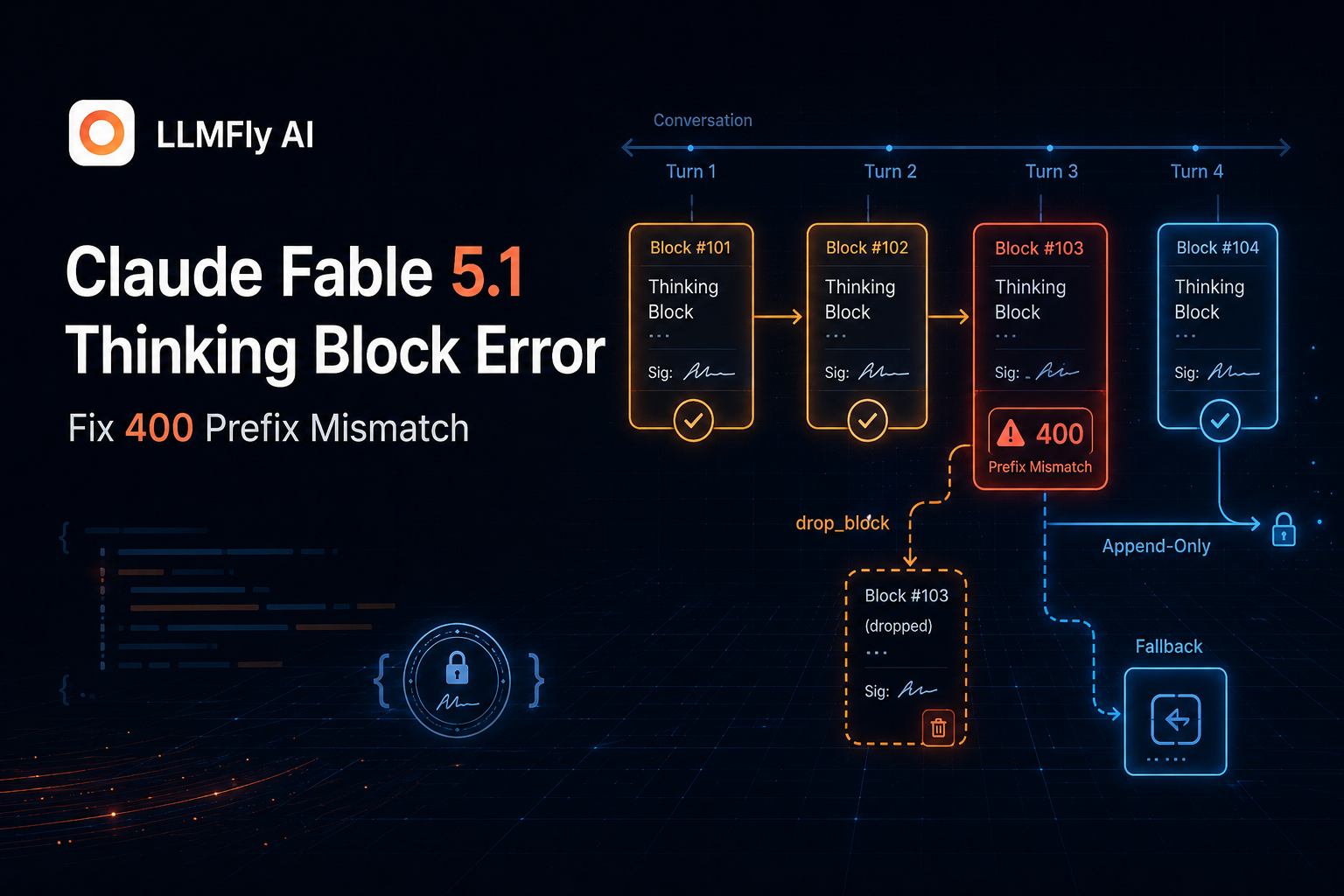
The Claude Fable 5.1 thinking block error is a new production issue for multi-turn applications that modify conversation history. If the API says a thinking block is “bound to a different conversation,” repeatedly sending the same request will not fix it. Your application must either keep the conversation prefix append-only or deliberately drop the invalid thinking blocks.
Quick fix: stop rewriting system, tools, or earlier messages after a thinking block has been created. For a controlled migration, add the beta header thinking-binding-controls-2026-08-01, set prefix_mismatch_behavior to drop_block, and log every item in input_transformations. Use error in CI when a mismatch should fail loudly.
What does the Claude Fable 5.1 thinking block error look like?
messages.{i}.content.{j}: Invalid signature in thinking block.
The block is bound to a different conversation.
Remove the block, or set
thinking.block_binding.prefix_mismatch_behavior to "drop_block".
Claude Fable 5.1 attaches a signature to each preserved thinking block. When your client sends that assistant turn back on the next request, the API uses the signature to verify two things: the current model is allowed to read the block, and everything before that block still matches the conversation in which it was created.
The verified prefix includes the top-level system prompt, the tool list, every earlier message, and referenced file contents. A tiny middleware change can therefore invalidate a later turn even when the visible user and assistant text looks unchanged.
Why did Anthropic add conversation-bound signatures?
The security goal is to prevent reasoning produced under one set of instructions from being replayed under a different, potentially adversarial set of instructions. Research published in August 2026 showed that portable encrypted reasoning traces could create anti-distillation, data-extraction, and prompt-injection risks across proprietary model APIs. Binding a thinking block to its original prefix makes that replay pattern much harder.
This is not merely a security-policy change. It changes a common architecture used by agent frameworks: receive an assistant turn, store selected fields, rebuild the history, inject new instructions, and send the reconstructed request back. With Fable 5.1, “equivalent” history is not always valid history. For reliable replay, the shared prefix should be byte-identical.
Who is affected first?
Anthropic enforces prefix binding by default for new accounts created on or after August 31, 2026 at 00:00 UTC. Older accounts can opt into the check by setting prefix_mismatch_behavior. Anthropic also says future models are expected to enforce the behavior more broadly, so older integrations should not treat a currently successful request as proof that they are compatible.
Tools and frameworks that let customers bring their own API key are especially exposed. A maintainer’s older development account may accept a history pattern that fails immediately for a new customer. Test with enforcement enabled before users discover the difference in production.
Which history changes trigger a prefix mismatch?
| History operation | Safe? | What to do instead |
|---|---|---|
| Append a new user or assistant turn | Yes | Keep the existing prefix unchanged |
| Edit, reorder, or delete an earlier message | No | Start a new compacted conversation if the old history must change |
| Rewrite the top-level system prompt mid-session | No | Append a mid-conversation system message |
| Add, remove, or rename tools in the top-level array | No | Use supported tool_addition or tool_removal blocks |
| Insert then remove a per-turn reminder | No | Use a turn-scoped system message with clear_at |
| Remove thinking blocks from the beginning | Yes | Remove only from the head of the chain |
| Remove a thinking block from the middle | No | Drop that block and every later thinking block |
Change max_tokens or cache-control markers | Yes | These request parameters are outside the verified prefix |
| Reuse a mutable image or document URL | No | Upload once and reference a stable file_id, or send base64 |
| Use server-side compaction or context editing | Yes | Prefer supported context-management features |
The chain behavior matters. Each thinking block records information about the previous block. You may remove blocks from the start of the history, but removing one in the middle invalidates every later thinking block.
Fix 1: make conversation history append-only
The durable fix is to treat the messages array as an event log. Store each assistant response exactly as returned, including thinking and redacted_thinking blocks, and append new turns after it. Do not rebuild the assistant turn from only visible text.
- Freeze the top-level system prompt and tool definitions for the session.
- Store block type, order, signature, and content without normalization.
- Append tool results after the original assistant turn.
- Create a new conversation boundary when a major instruction rewrite is unavoidable.
- Hash or diff consecutive request prefixes during testing.
This design also improves prompt-cache stability. The same history mutations that break signature validation frequently restart the prompt cache. Since Fable 5.1 cache reads cost $0.25 per million tokens—75% less than Fable 5—preserving a stable prefix can improve both reliability and cost per completed task.
Fix 2: use drop_block during migration
If your application must continue even when an old thinking block no longer matches, use the beta control below. This removes the first mismatched thinking block and all later thinking blocks in the chain, then lets the request continue. Dropped blocks are not billed.
curl https://api.anthropic.com/v1/messages \
  -H "content-type: application/json" \
  -H "x-api-key: $ANTHROPIC_API_KEY" \
  -H "anthropic-version: 2023-06-01" \
  -H "anthropic-beta: thinking-binding-controls-2026-08-01" \
  -d '{
    "model": "claude-fable-5-1",
    "max_tokens": 16000,
    "thinking": {
      "type": "adaptive",
      "block_binding": {
        "prefix_mismatch_behavior": "drop_block"
      }
    },
    "system": "You are a coding agent.",
    "messages": []
  }'
The beta header is required. Sending thinking.block_binding without it returns another 400 error ending in block_binding: Extra inputs are not permitted.
Log input_transformations on every turn
{
  "input_transformations": [
    {
      "type": "thinking_dropped",
      "path": "messages.1.content.0",
      "reason": "prefix_binding_mismatch"
    }
  ]
}
An empty array means the tested history remained valid. A prefix_binding_mismatch means something before the reported path changed. Diff the shared portions of system, tools, and messages between consecutive requests.
A model_binding_mismatch means the conversation moved to a model that cannot read the earlier model’s thinking blocks. This can occur after routing or fallback and is not automatically an integration bug. Other documented reasons include organization and end-user binding mismatches. Log each reason separately; otherwise a dashboard can turn a model transition, a tenancy bug, and an accidental history edit into one indistinguishable error count.
What changes for model routers and fallbacks?
Multi-model systems must now manage two independent questions: can the next model read the previous model’s thinking blocks, and does the conversation prefix still match? A fallback can be technically available but unable to consume reasoning produced by the primary model.
- Pin long-running sessions to a model version unless a fallback is necessary.
- Log the requested model and the model that actually served each turn.
- Do not reuse one mutable history object across concurrent branches.
- Test both provider-side and application-side fallbacks with real multi-turn histories.
- Keep refusal fallback separate from retries for 429, 529, timeouts, and 5xx errors.
- Verify that any OpenAI-compatible layer exposes the model-specific controls your workflow requires.
A unified access service can reduce the work of maintaining separate credentials, balances, base URLs, and model catalogs. It does not erase provider-specific state rules. If your Claude workflow depends on beta headers or native thinking-block fields, test the exact route before production.
For teams evaluating several providers, LLMFly AI can keep model access, project keys, and usage comparison behind one account. Use the Model Plaza to verify the currently available Fable 5.1 route and rate, then run an isolated staging conversation that exercises history mutation, fallback, and compaction. Our OpenAI-compatible vs Anthropic-compatible API guide explains why payload compatibility and model semantics are different questions.
A practical CI test for frameworks and BYOK apps
- Start a Fable 5.1 conversation and preserve the complete assistant response.
- Send a valid second turn with the original prefix and confirm no transformation occurs.
- Repeat after changing one earlier user message; use
errorso CI sees the 400. - Repeat with
drop_blockand assert thatinput_transformationsreportsprefix_binding_mismatch. - Change the system prompt, tool name, tool schema, and a mutable file URL one at a time.
- Run the same suite with a newly created customer-style account or explicit enforcement.
- Test a cross-model fallback and assert that
model_binding_mismatchis classified separately.
Do not retry the unchanged 400 in a loop. The error is permanent for that request body. Either repair the history, remove invalid thinking blocks and retry once, or use the documented drop behavior.
Claude Fable 5.1 thinking block error checklist
- Messages are append-only during a session.
- Assistant turns are replayed exactly, with every block type preserved.
- Top-level system prompts and tools remain fixed.
- Temporary reminders use turn-scoped system messages.
- Tool changes use supported mid-conversation blocks.
- Compaction does not leave thinking blocks behind a rewritten prefix.
- Cross-turn files use stable IDs or base64, not mutable URLs.
input_transformationsand all mismatch reasons are monitored.- Production has an explicit
errorordrop_blockpolicy. - Fallback tests cover incompatible model histories.
Frequently asked questions
Why does the error appear only for some API keys?
New accounts created on or after August 31, 2026 have prefix binding enforced by default. Older accounts may not fail unless they explicitly opt into enforcement, which is why a maintainer can miss a bug that affects new BYOK users.
Is drop_block the permanent solution?
It is a useful continuity and migration policy, but it should not hide unintended history mutation. Log every dropped block. If a mismatch can only indicate a software defect in your architecture, use error in production or at least in CI.
Does removing dropped thinking reduce the bill?
Anthropic says blocks removed by drop_block are not billed. However, the model must reason again without that preserved state, so total task cost and latency can still rise. Measure completed-task cost rather than treating free dropped tokens as a saving.
Do Claude Code or the Claude Agent SDK need this fix?
Anthropic says its managed products already preserve the conversation prefix correctly. The main risk is in custom Messages API clients, middleware, routers, frameworks, and BYOK tools that rebuild or mutate history.
Final recommendation
The Claude Fable 5.1 thinking block error is best treated as a state-integrity signal. Build append-only histories first, use drop_block to expose hidden mutations during migration, and make mismatch reasons visible in logs. Then test model routing and fallback as part of the same conversation-state system.
If you want to compare routes without maintaining separate provider accounts, start with the LLMFly AI quickstart and an isolated staging key. Confirm the exact model and compatibility behavior before moving a live agent conversation. You can create an account here.
Leave a Reply