
Last reviewed: September 3, 2026.
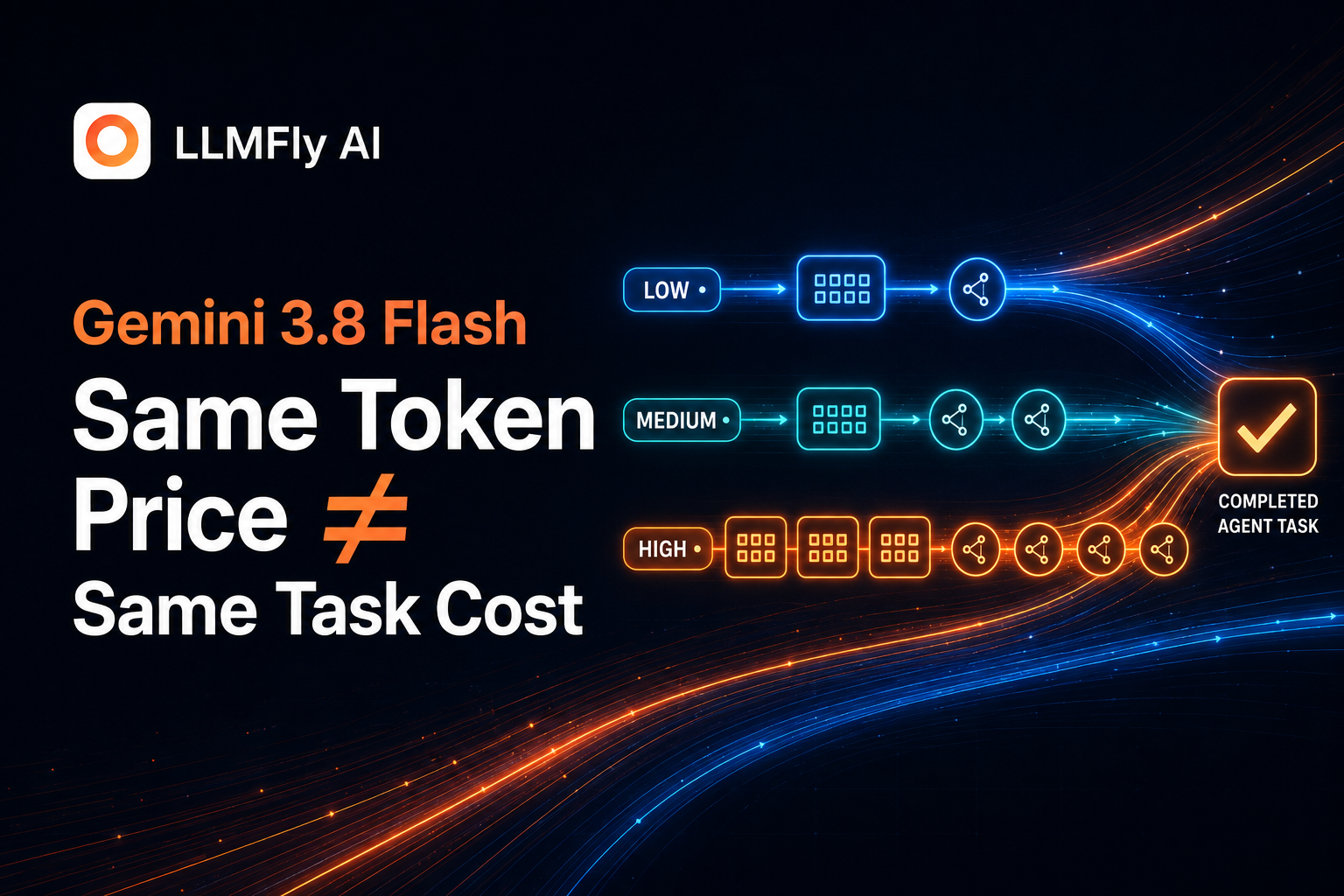
Gemini 3.8 Flash keeps the same introductory API price as Gemini 3.7 Flash, but it does not necessarily produce the same bill. Google charges $0.75 per million input tokens and $3.75 per million output tokens through December 31, 2026. Independent testing from Artificial Analysis found that Gemini 3.8 Flash at high reasoning cost about $0.58 per benchmark task—roughly 40% more than 3.7 Flash—because it generated about 30% more output tokens and took more turns on agent evaluations.
That does not make Gemini 3.8 Flash expensive. It makes cost per completed task more useful than price per million tokens. The new model reaches a higher level of intelligence, coding performance, and tool use at a low unit price. Developers simply need to choose the right thinkingLevel, cap agent loops, and compare accepted results instead of assuming an unchanged rate card means unchanged spend.
Gemini 3.8 Flash API pricing at a glance
| Item | Through Dec. 31, 2026 | From Jan. 1, 2027 |
|---|---|---|
| Standard input | $0.75 / 1M tokens | $1.50 / 1M tokens |
| Standard output | $3.75 / 1M tokens | $7.50 / 1M tokens |
| Context window | 1M tokens | 1M tokens |
| Maximum output | 64K tokens | 64K tokens |
| Thinking levels | Low, medium, high | Low, medium, high |
| Default thinking level | Medium | Medium |
The introductory rate is temporary. Google’s official announcement says the input and output rates double on January 1, 2027. A production cost model should therefore contain both today’s rate and the scheduled rate, especially if you are pricing annual contracts or launching an agent that may scale after the introductory period.
Why the same token price can cost 40% more per task
Google describes Gemini 3.8 Flash as a model that “works harder.” On difficult requests, it can perform additional reasoning steps and call tools iteratively. Google also warns that it may consume more tokens to maximize performance, particularly at higher effort levels.
Artificial Analysis measured the effect across its Intelligence Index:
| Configuration | Intelligence score | Cost per task | Time per task |
|---|---|---|---|
| Gemini 3.8 Flash, high | 59 | $0.58 | 2.5 minutes |
| Gemini 3.8 Flash, medium | 57 | $0.41 | Not reported in the release summary |
| Gemini 3.8 Flash, low | 52 | $0.24 | 0.8 minutes |
| Gemini 3.7 Flash, high | 56 | $0.40 | 2.2 minutes |
At high reasoning, Gemini 3.8 Flash generated an average of about 48,000 output tokens in the evaluation. Its cost per task rose even though the input and output prices did not. The model bought a three-point intelligence gain by doing more work.
This distinction matters most for agents. A normal chat request may end after one response. A coding agent can inspect files, search the repository, call tools, run tests, revise a plan, and repeat. Each extra turn can add new tool results and new output tokens. The model can be cheap per token and still exceed the budget if the loop has no stop condition.
Calculate a realistic Gemini 3.8 Flash task cost
Start with the complete billable path, not the final response alone:
task cost =
  input tokens × input rate
  + output and thinking tokens × output rate
  + paid tool or search calls
  + retries and repair requests
  + validation-model cost
At the introductory standard rate, a one-turn request with 40,000 uncached input tokens and 12,000 output tokens costs about $0.075: $0.03 for input and $0.045 for output. If a higher thinking level increases output by 30%, the same simplified request reaches about $0.0885 before counting additional turns or tools. The absolute amount is still small, but at one million tasks that difference becomes $13,500.
Next, divide spend by accepted results. Suppose an older configuration costs $0.40 per attempt and passes 60% of the time. Its effective model cost is about $0.67 per accepted task. A 3.8 Flash configuration costing $0.58 per attempt but passing 95% of the time costs about $0.61 per accepted task. In that example, the more expensive attempt is the cheaper production choice. If both pass at the same rate, the conclusion reverses.
Use your measured token counts rather than these illustrative values. Include failed runs, timeouts, safety refusals, and human repair work. Excluding them makes unreliable configurations appear artificially cheap.
Is the higher cost per task worth it?
Often, yes. The correct comparison is not $0.58 versus $0.40 in isolation. It is the total cost of reaching an acceptable result.
- If 3.7 Flash fails and requires a second run, a successful 3.8 Flash request may be cheaper overall.
- If a developer must spend twenty minutes repairing the cheaper output, model tokens are not the dominant cost.
- If 3.8 Flash solves a multi-file change in one agent run, the extra reasoning can replace several manual steps.
- If the task is simple extraction or classification, the extra work may add no business value.
Google reports that Gemini 3.8 Flash improves on 3.7 Flash in long-horizon software engineering, autonomous agents, finance, legal work, and multi-step reasoning. It scored 54.9% on HLE-Verified and outperformed most larger frontier models on DeepSWE v1.1. Independent testing found that the model’s largest gains came from agentic evaluations including tool use and coding.
The model also accepts text, images, audio, video, and files within its one-million-token context window. That can remove preprocessing steps in document, media, support, and compliance workflows. Measure that system-level saving too: a slightly more expensive multimodal request may replace transcription, OCR, frame extraction, or a separate vision-model call. The comparison should include every component needed to produce the same final output.
Early developer reaction reflects that tradeoff. Aigora.ai CEO John Ennis described the model as offering Opus-level coding quality at a fraction of the cost and highlighted video-generation workflows as a promising use case. That is a useful signal, but it is not a substitute for testing your own repository, tools, and acceptance criteria.
Choose low, medium, or high thinking by task
Gemini 3.8 Flash supports low, medium, and high thinking levels. Medium is the API default. A sensible production policy is to start below the maximum and escalate only when validation shows that deeper reasoning improves the result.
| Thinking level | Good starting workloads | Watch for |
|---|---|---|
low | Classification, extraction, rewriting, simple code changes | Insufficient search, planning, or verification |
medium | General coding, tool use, business analysis, multimodal work | Unnecessary steps on easy high-volume requests |
high | Difficult debugging, repository-wide refactors, long agent tasks | More output tokens, turns, latency, and tool calls |
Artificial Analysis found that low reasoning reduced measured cost per task from $0.58 to $0.24 and time per task from 2.5 minutes to 0.8 minutes. The intelligence score fell from 59 to 52, but that difference may be irrelevant for an easy workload. The cheapest configuration is the lowest thinking level that consistently passes your checks.
How to set thinkingLevel in the Gemini API
from google import genai
from google.genai import types

client = genai.Client()

response = client.models.generate_content(
    model="gemini-3.8-flash",
    contents="Review this pull request and identify concurrency bugs.",
    config=types.GenerateContentConfig(
        thinking_config=types.ThinkingConfig(
            thinking_level="medium"
        )
    ),
)

print(response.text)
Do not select a thinking level from one anecdotal prompt. Build a small evaluation set containing normal requests, difficult requests, and common failure cases. Record quality, input tokens, output tokens, number of turns, tool calls, latency, and human correction time for each level.
Control the whole agent loop, not only model output
A per-request token limit is necessary but incomplete. Production agents need controls around the model:
- Maximum agent turns per task.
- Maximum total input, output, and thinking tokens.
- Maximum tool calls and separate quotas for expensive tools.
- Maximum wall-clock runtime.
- Maximum retry count by error category.
- Maximum number of parallel workers or subagents.
- Human approval for deletion, deployment, payment, messaging, or permission changes.
- A deterministic validator for tests, schemas, counts, and citations.
Track why a loop ended. “Passed validation,” “reached turn limit,” “tool failed,” and “human approval required” describe different problems. Combining them into one generic failure rate hides whether the model, tool integration, or budget policy needs adjustment.
A cost-per-accepted-task evaluation
- Select 30 to 100 real requests from production.
- Define an automatic or human acceptance test before running them.
- Test Gemini 3.8 Flash at low, medium, and high thinking.
- Include Gemini 3.7 Flash and at least one credible non-Google alternative.
- Record every request, retry, tool call, cache hit, and validation result.
- Add human review time when the output needs correction.
- Divide total cost by the number of accepted results.
- Route each task class to the cheapest configuration that meets its service level.
This method may produce several winners. High reasoning can win repository refactors; medium can win interactive coding; low can win structured extraction. A smaller model may remain best for repetitive transformations. A single global default throws away those savings.
What changes when migrating to Gemini 3.8 Flash?
Google lists several integration changes that matter when moving an existing Gemini client:
- Change the model ID to
gemini-3.8-flash. - Remove
temperature,top_p, andtop_kfrom generation settings. - Replace the numeric
thinking_budgetwith thethinking_levelstring. - Do not use the unsupported
minimalthinking level. - Remove
candidate_count. - Remove prefilled model turns and ensure the final user turn contains text.
- Preserve Gemini thought signatures in multi-turn conversations.
- For
generateContent, include bothcall_idandnamein function responses.
Run a staging conversation that includes tool use, multiple turns, a large context, and an intentional failure. A request that succeeds as a one-shot prompt can still fail when your framework reconstructs history or normalizes function-call fields.
Where a unified API workflow helps
The release cadence is becoming a deployment problem of its own. Gemini 3.8 Flash is Google’s third Flash release in six weeks. Teams that maintain separate accounts, balances, model lists, and evaluation scripts for every provider spend more time on access management just as models become cheaper and change faster.
A unified access layer is useful when you need to compare Gemini 3.8 Flash with Claude, GPT, or other models on the same production-shaped task set. With LLMFly AI, teams can create separate project keys, review supported routes in the Model Plaza, and keep usage experiments behind one account. Availability, rates, and model-specific fields should still be verified on the exact route before deployment.
For OpenAI-compatible clients, our API compatibility guide explains why a shared request shape does not make every provider behavior identical. The same principle applies to Gemini thinking controls, tool responses, and multimodal payloads.
Frequently asked questions
How much does Gemini 3.8 Flash cost?
Through December 31, 2026, Google’s introductory standard rate is $0.75 per million input tokens and $3.75 per million output tokens. On January 1, 2027, those rates are scheduled to double to $1.50 and $7.50.
Why can Gemini 3.8 Flash cost more than 3.7 Flash?
The unit prices are currently the same, but 3.8 Flash may perform more reasoning, generate more output tokens, and take more agent turns. Artificial Analysis measured about 40% higher cost per task at high reasoning.
Which thinking level should I use?
Start with medium, the API default. Test low for high-volume or simpler tasks and high for difficult coding or long-horizon agents. Promote a level only when it improves cost per accepted result.
Should I replace Gemini 3.7 Flash immediately?
Not for every workload. Google continues to support 3.7 Flash and explicitly recommends it when compute efficiency is the priority. Migrate the task classes that benefit from 3.8’s stronger reasoning and agent behavior first.
Final recommendation
Gemini 3.8 Flash moves frontier-level coding and agent capability deeper into the Flash price range. Its main pricing lesson is equally important: cheaper intelligence does not mean every request becomes cheaper. Measure the whole loop, start at medium or low when possible, enforce external stop conditions, and pay for high reasoning only where it increases the rate of accepted outcomes.
To run a controlled comparison across model families, start with the LLMFly AI quickstart, create a staging-only project key, and verify the latest Gemini route in the Model Plaza. You can create an account here.
Leave a Reply