
Last reviewed: October 8, 2026
Quick answer: What is the best PackyAPI alternative in 2026?
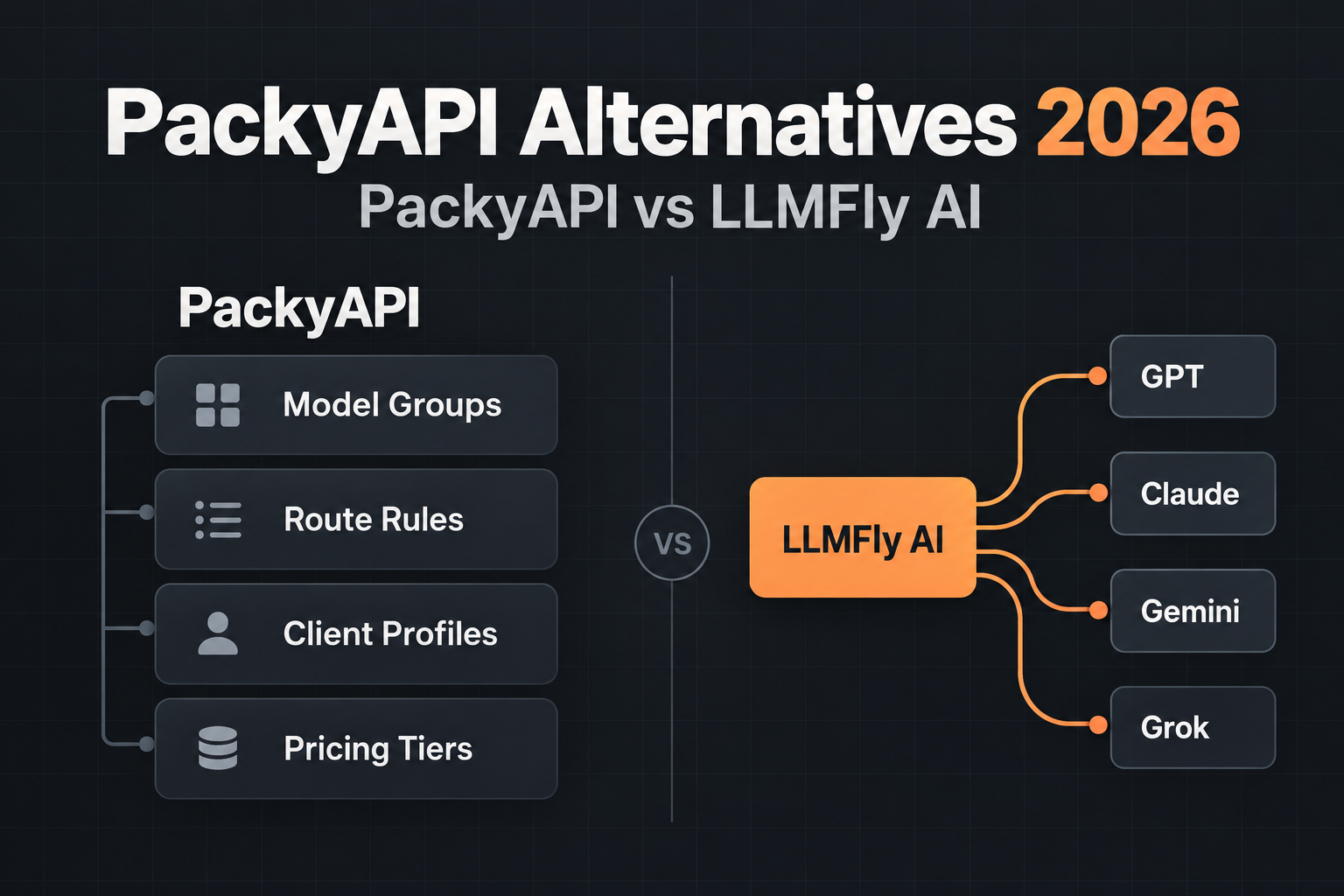
LLMFly AI is a strong PackyAPI alternative for developers who want affordable access to a focused set of leading GPT, Claude, Gemini, and Grok models without navigating a large catalogue of token groups. PackyAPI remains useful when granular group selection, specialized routes, and its broader integration catalogue are the priority. LLMFly AI is the simpler choice when the goal is to connect Claude Code, Codex, Cursor, or another supported client, keep separate keys under one account, and compare current model prices in one place.
The practical decision is not which platform has the larger discount headline. Compare the exact model, supported client, API behavior, cache pricing, retry rate, latency, and cost per accepted task. As of October 8, 2026, LLMFly AI advertises a 0.3× billing multiplier for its ChatGPT/Codex model group, 0.5× for Claude Code, and 0.4× for selected Gemini and Grok routes. Confirm the live rate in Model Plaza before funding production traffic.
How do PackyAPI and LLMFly AI compare?
| Criterion | PackyAPI | LLMFly AI |
|---|---|---|
| Product approach | Multi-model platform organized around detailed token groups and route types | Multi-model AI API platform focused on affordable access to leading models |
| Model selection | Select a compatible group first, then a model | Select the supported client or model group, then copy the exact model ID from Model Plaza |
| Claude Code | Dedicated Claude Code groups and CC Switch documentation | Dedicated Claude Code configuration shown in the console; CC Switch recommended |
| Codex | Dedicated Codex group and configuration guide | Codex setup guide with the current compatible endpoint and exact model IDs |
| Gemini workflows | Recommends compatible clients such as Cline, Roo Code, or OpenCode rather than Gemini CLI | Gemini routes available; verify the client and model combination before production use |
| Pricing | Varies by token group, route, and model | Live input, output, and cache prices shown by model; selected groups currently priced below provider reference rates |
| Best fit | Users who value detailed route groups and a broad set of specialized configurations | Developers who already know which leading models they need and want a more direct path to lower-cost access |
What is PackyAPI?
PackyAPI is a multi-model API platform that provides access to Claude, GPT, Gemini, Codex, and other AI services. Its documentation organizes access through token groups. The group controls the models, compatible clients, route type, and sometimes whether third-party clients are allowed.
This structure provides granular control, but it makes the group part of the integration contract. PackyAPI’s current quick-start guide warns that choosing the wrong group can produce a model-not-found error. Its group documentation also distinguishes between Claude Code-only groups, third-party-compatible Claude groups, Codex groups, official-provider routes, discounted routes, and other specialized options.
PackyAPI also documents CC Switch as a convenient way to manage Claude Code and Codex provider profiles. This is helpful if you already understand its group system and want to switch configurations without repeatedly editing local files.
What is LLMFly AI?
LLMFly AI is a multi-model AI API platform for accessing a curated set of leading GPT, Claude, Gemini, and Grok models. Its product center is narrower than a broad model marketplace: it focuses on popular frontier models, current model releases, developer tools, and prices that may be below official reference rates.
One account can hold separate application keys and a shared balance. Developers can configure supported coding agents and desktop clients using the endpoint and model information shown in the console. The public model directory explains model families and workloads, while Model Plaza remains the source of truth for the model IDs, routes, prices, and availability attached to an account.
API compatibility is protocol compatibility, not model equivalence. A Claude model does not behave like a GPT model merely because both can be reached through a compatible client. Tool calls, reasoning controls, streaming events, safety behavior, and optional endpoints still require model-specific testing.
Why do developers look for a PackyAPI alternative?
The most common reason is not that PackyAPI lacks models. It is that some developers want fewer configuration decisions between creating an account and completing a first request.
A PackyAPI alternative may be worth testing when you need:
- A smaller catalogue centered on widely used frontier models;
- A more direct setup path for Claude Code, Codex, Cursor, or another known client;
- Clear input, output, and cache prices instead of comparing group multipliers alone;
- Separate keys for development, production, and individual tools under one balance;
- A lower effective cost on the models your workload already uses;
- A second provider for staging tests or operational fallback.
None of these requirements proves that a migration will improve production results. The alternative must pass the same tool-calling, streaming, latency, reliability, and billing tests as the current route.
Is LLMFly AI cheaper than PackyAPI?
There is no honest platform-wide answer because both catalogues are dynamic and the two services do not always expose identical routes. Compare one exact model and one supported client at a time.
LLMFly AI’s public pricing page currently shows the following group-level positioning:
- ChatGPT/Codex routes: a 0.3× billing multiplier, or 70% below the listed provider reference price for the supported models shown;
- Claude Code routes: selected models at a 0.5× multiplier;
- Gemini routes: selected models at a 0.4× multiplier;
- Grok routes: selected models at a 0.4× multiplier.
Do not apply those multipliers again to prices already displayed in the LLMFly AI column. The displayed platform prices include the relevant multiplier. Availability, long-context tiers, cache charges, tools, taxes, top-up fees, and account-specific conditions can still change the final amount.
PackyAPI likewise instructs users to consult its live Model Plaza because prices and group multipliers vary. An old screenshot or comparison post is not a reliable budget.
Use this workload formula:
task_cost =
  uncached_input_cost
  + cache_write_cost
  + cache_read_cost
  + output_and_reasoning_cost
  + tool_cost
  + retry_cost

cost_per_accepted_task = total_task_cost / accepted_results
For a fuller cost framework, read How to Compare LLM API Prices in 2026.
Which platform is better for Claude Code?
Both platforms support Claude Code, but setup details matter.
PackyAPI documents multiple Claude-related groups. Some are intended only for Claude Code, while others permit third-party clients. Its documentation says the group must match the intended use and warns that restrictions can differ.
LLMFly AI gives Claude Code a separate Anthropic-format setup. Its documentation explicitly tells users not to insert the general OpenAI-compatible address into Claude Code. Instead, copy the Claude Code configuration from the console’s Use Key dialog. LLMFly AI also recommends CC Switch for managing profiles without repeatedly changing environment variables.
Choose between them by testing the exact Claude model you need. Verify prompt caching, thinking blocks, tool loops, streaming, long contexts, refusal behavior, and what happens when a request is retried. A successful one-line prompt is only a connectivity test.
Which platform is better for Codex?
PackyAPI provides a dedicated Codex group and configuration guide. LLMFly AI also publishes a Codex setup path and currently offers discounted ChatGPT/Codex-group pricing for supported models.
Before switching an existing Codex workflow, verify more than the Base URL:
- The route supports the endpoint behavior required by your Codex version;
- The selected model ID is available to the key;
- Streaming produces complete, correctly ordered events;
- Tool calls and structured outputs match the schemas your workflow expects;
- Reasoning controls and long-running tasks behave consistently;
- The usage log resolves to the expected model and price.
Keep the old provider profile until the new one passes a representative regression set.
How do you migrate from PackyAPI to LLMFly AI?
- Create a dedicated test key. Do not reuse a production key or a key exposed in screenshots and repositories.
- Choose the client first. Open the relevant LLMFly AI guide for Claude Code, Codex, or your other tool.
- Copy the exact configuration. Use the console’s endpoint and the exact case-sensitive model ID from Model Plaza.
- Run a small request. Confirm authentication, model identity, streaming, and the first billing record.
- Run a fixed evaluation set. Use 20–50 production-shaped tasks with predefined acceptance criteria.
- Compare effective cost. Include cache, reasoning, tools, failed requests, retries, and human correction time.
- Move a small traffic percentage. Monitor errors, latency, output quality, and spend before increasing traffic.
- Keep a rollback profile. Do not remove the previous provider until the new route is stable.
What should you test before using a PackyAPI alternative in production?
| Test | What to record |
|---|---|
| Model identity | Requested model ID, resolved model, and usage-log entry |
| Output quality | Acceptance rate on the same tasks and review rubric |
| Streaming | Time to first token, event ordering, dropped chunks, and completion rate |
| Tool calling | Schema validity, tool selection, recovery after tool errors, and loop count |
| Reliability | Timeouts, 429s, 5xx errors, retries, and fallback behavior |
| Cost | Input, output, cache, reasoning, tools, retries, and cost per accepted result |
| Security | Key storage, revocation, retention terms, logs, and access controls |
For a broader shortlist, see the 10 best LLM API providers for startups in 2026 and the best OpenRouter alternatives comparison.
Who should choose PackyAPI?
- You want granular token groups and specialized route choices;
- You already understand its group compatibility rules;
- You rely on a PackyAPI-specific client guide or integration;
- Your evaluation shows that its selected route is more reliable or economical for your workload.
Who should choose LLMFly AI?
- Your shortlist is mainly leading GPT, Claude, Gemini, and Grok models;
- You use Claude Code, Codex, Cursor, or other supported developer tools;
- You want current input, output, and cache prices alongside provider reference prices;
- You want separate application keys under one account and balance;
- You want to test current discounted routes without adopting a very broad model marketplace.
Start with a small request, then confirm the charged amount in the usage record. Do not fund a full production workload based only on a landing-page discount.
Frequently asked questions
Is PackyAPI the same as PackyCode?
PackyAPI is also referred to as PackyCode in parts of its ecosystem and older material. Use the current PackyAPI website and documentation when checking groups, prices, and configuration.
Can one LLMFly AI account access GPT, Claude, Gemini, and Grok?
Yes, when those routes are available to the account. Use separate keys for different applications and copy current model IDs from Model Plaza.
Can I use the same Base URL for Claude Code and Codex?
No. Claude Code uses Anthropic-specific configuration, while Codex uses its compatible configuration path. Copy the values shown for each client instead of assuming one endpoint supports every protocol.
What is the cheapest PackyAPI alternative?
No provider is cheapest for every workload. LLMFly AI currently offers material discounts on supported leading-model routes, but the correct comparison is total cost per accepted task after cache, output, reasoning, tools, and retries.
Should I migrate production traffic immediately?
No. Create a staging key, run a representative evaluation, move a small traffic percentage, and keep a rollback path. Require approval before coding agents perform destructive operations regardless of the API platform.
Bottom line
PackyAPI and LLMFly AI overlap, but their product centers are different. PackyAPI emphasizes detailed groups and route selection. LLMFly AI emphasizes affordable access to a focused set of leading models with direct setup paths for widely used AI tools.
If you already know that your workload needs GPT, Claude, Gemini, or Grok, LLMFly AI is a practical PackyAPI alternative to test. Compare one exact model and client at a time, validate the usage record, and choose the provider with the best combination of accepted-task cost, reliability, latency, and integration effort.
Leave a Reply