
Last reviewed: August 26, 2026. API features and pricing change; verify current official documentation before production rollout.
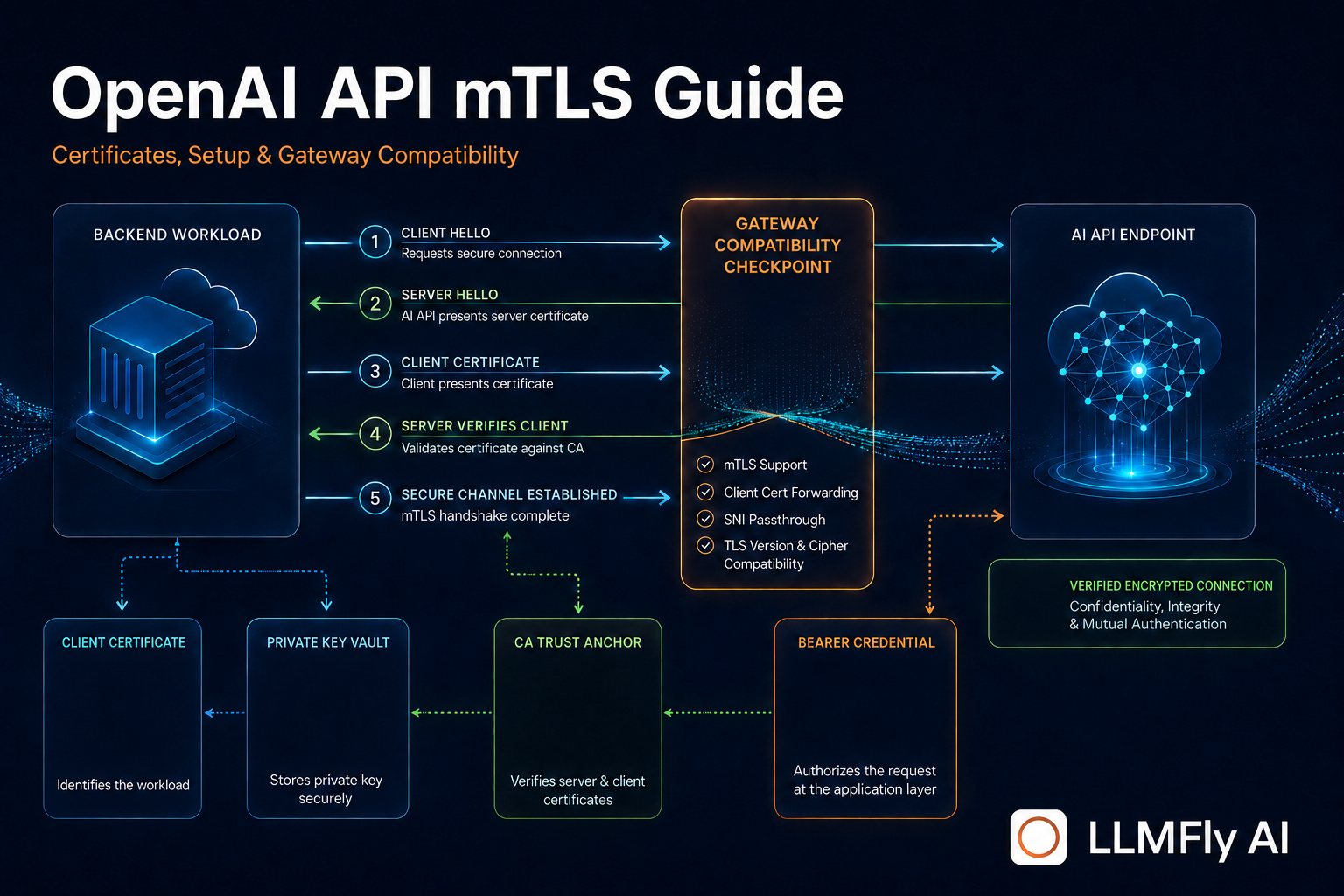
OpenAI API mTLS adds client-certificate authentication at the transport layer while normal bearer authorization still applies. This guide covers architecture, setup, rotation, and gateway compatibility.
In this guide
- What mutual TLS changes
- Choose mTLS for the right threat model
- Design the certificate hierarchy
- Protect the private key
- Enable the correct OpenAI scope
- Send both certificate and bearer credential
- Test the failure modes
- Rotate certificates safely
- Proxies and gateways complicate identity
- LLMFly AI compatibility checkpoint
What mutual TLS changes
Normal TLS authenticates the server to the client and encrypts traffic. Mutual TLS also requires the client workload to present a trusted certificate. OpenAI’s guide describes mTLS as an additional layer; the request still needs its regular bearer credential for application-level authorization.
Choose mTLS for the right threat model
mTLS is useful when a production workload can securely hold a private key and the organization requires strong workload identity, network-layer admission, or certificate-based controls. It adds PKI and operational complexity. For low-risk prototypes, strong secret management and standard TLS may be the practical baseline.
Design the certificate hierarchy
Use an approved certificate authority, documented subject or SAN conventions, short-lived client certificates where practical, and separate issuance for environments. Protect CA signing keys. Track serial number, owner, workload, issue time, expiry, and revocation status without copying private keys into inventories.
LLMFly AI
One Affordable API.
Claude, GPT, Gemini and more — through one affordable API. Use separate keys and unified usage tracking for supported model workflows.
Protect the private key
Generate or import the key inside a managed vault, HSM, sidecar, or protected workload identity system when possible. Restrict filesystem permissions and prevent logs, crash dumps, images, and backups from capturing it. Certificate files are public; the corresponding private key is the sensitive asset.
Enable the correct OpenAI scope
Follow the official mTLS enrollment and activation steps for the relevant organization or project. Verify the documented hostname, trust chain, client certificate format, and project behavior. Test with a dedicated non-production credential before touching critical traffic.
Send both certificate and bearer credential
Configure the HTTP client with the client certificate, private key, CA trust, SNI, and modern TLS settings. Then attach the normal Authorization header. Diagnose handshake failures separately from HTTP errors: a TLS failure occurs before the API can return a normal 401 or 403.
Test the failure modes
Confirm success with a valid certificate and bearer token. Then test expired, revoked, untrusted, wrong-project, missing-certificate, wrong-SNI, and invalid-bearer cases. Make alerts distinguish PKI failure, authentication failure, authorization failure, and model-service failure.
Build a cleaner multi-model workflow
Keep provider configuration, application keys, and usage visibility in one operational layer while testing every compatibility-sensitive feature.
Rotate certificates safely
Issue the replacement before expiry, deploy it to a canary, verify handshakes and API calls, roll out, then revoke or retire the old certificate. Support overlapping trust only as long as policy allows. Alert well before expiration and rehearse emergency revocation.
Proxies and gateways complicate identity
A TLS-terminating proxy becomes the mTLS client toward the upstream unless it supports a documented passthrough or re-origination design. Client-certificate forwarding headers are not equivalent to end-to-end mTLS unless both parties explicitly trust and validate that architecture.
LLMFly AI compatibility checkpoint
Do not assume OpenAI API mTLS works through LLMFly AI or any OpenAI-compatible gateway. Confirm endpoint hostname, certificate enrollment, TLS termination, SNI, bearer credential, and upstream support with the gateway operator. If the requirement is specifically OpenAI mTLS, the safest default is the official endpoint until support is documented and tested.
OpenAI API mTLS: production checklist
- Keep secrets server-side and redact logs.
- Pin configuration and test changes with representative evaluations.
- Measure latency, usage, errors, and cost per successful task.
- Use bounded retries and a documented rollback path.
- Verify gateway compatibility for provider-specific features.
Frequently asked questions
No. OpenAI documents mTLS as an additional transport control; normal bearer authorization still applies.
In a managed vault, HSM, protected sidecar, or tightly restricted workload filesystem.
The TLS handshake can fail before an HTTP request reaches the API.
Only with an explicitly designed passthrough or trusted re-origination architecture; test the exact deployment.
Do not assume it. Confirm documented support and test certificate, SNI, and routing behavior before production.
Official sources
This article is technical guidance, not a guarantee of service compatibility, security certification, or current provider pricing.
Leave a Reply