
Last reviewed: September 2, 2026.
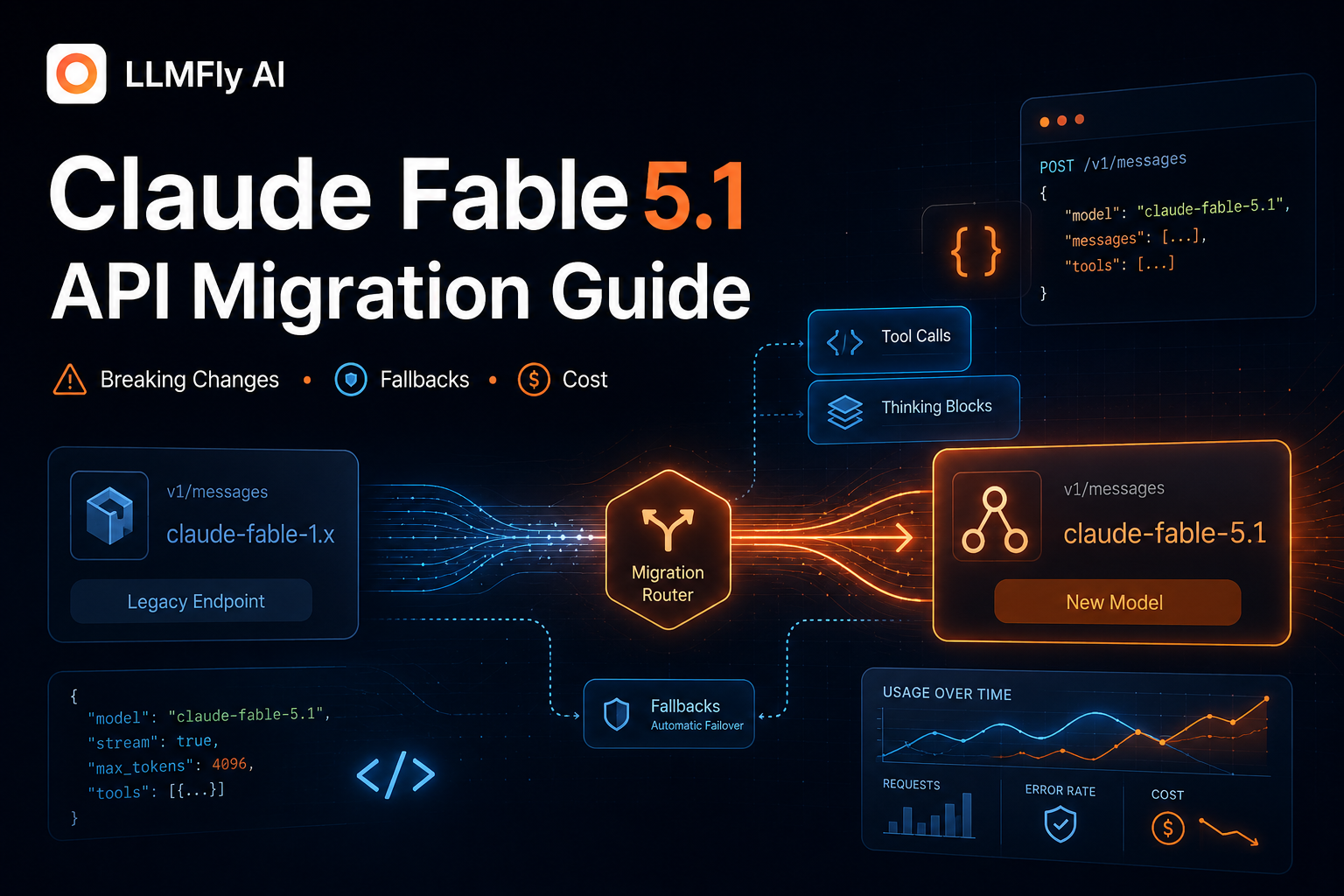
A Claude Fable 5.1 API migration can look like a one-line model-name change. In a production application, it is not. Teams also need to account for conversation-bound thinking blocks, forced tool calls, HTTP 200 refusals, fallback behavior, prompt-cache economics, and the possibility that a successful request is served by a different model than the one originally requested.
Quick answer: change the model ID to claude-fable-5-1, then test your response parser, tool loop, conversation-history storage, refusal handling, retries, cost telemetry, and rollback path. Do not send all production traffic to the new model until those checks pass on your own prompts and tools.
Claude Fable 5.1 API migration: what actually changes?
Fable 5.1 keeps the same published input and output prices as Fable 5: $10 per million input tokens and $50 per million output tokens. The major pricing change is prompt-cache reads at $0.25 per million tokens, 75% lower than Fable 5. Anthropic estimates that this reduces the cost of a typical workload by about 25%, and highly agentic workloads by as much as roughly 45%.
Those savings matter most when an agent repeatedly reads the same large system prompt, repository context, tool definitions, or documents. They do not make every request cheaper automatically. If your cache misses, your agent rewrites whole files, or your retry logic repeats uncached context, the headline saving can disappear.
| Migration area | What can fail | Production fix |
|---|---|---|
| Model name | Invalid or unavailable model | Use the exact model ID exposed by your provider and keep it in configuration, not application code |
| Thinking blocks | content[0].text is missing, or a later turn returns 400 | Parse blocks by type; store and replay thinking blocks unchanged |
| Conversation history | “Bound to a different conversation” errors | Keep history append-only; do not rewrite the system prompt, tools, or earlier messages |
| Forced tool use | A request that previously worked now errors | Remove forced-tool assumptions and test the supported tool-choice behavior |
| Refusals | Application treats an HTTP 200 as success | Inspect stop_reason and handle refusal as a separate outcome |
| Fallback | Silent quality change or duplicate billing | Log the served model, fallback metadata, iterations, and cache usage |
| Retries | 429, 529, or 5xx failures still reach users | Keep transport retries separate from safety-refusal fallback |
Can you upgrade by changing only the model ID?
Only for a simple, stateless request whose client already parses typed content blocks. A minimal request can start like this:
from anthropic import Anthropic

client = Anthropic()

message = client.messages.create(
    model="claude-fable-5-1",
    max_tokens=4096,
    messages=[
        {"role": "user", "content": "Review this pull request for correctness."}
    ],
)

text = "\n".join(
    block.text for block in message.content
    if block.type == "text"
)
The last six lines are more important than they look. Fable-class responses can begin with thinking blocks before the first text block. Code that assumes the first item is text may crash, return an empty answer, or discard information needed for the next tool-use turn.
1. Treat thinking blocks as conversation state
Fable 5.1 tightens the relationship between thinking blocks and the conversation that created them. The safest pattern is simple: append each assistant response exactly as returned, including thinking and redacted-thinking blocks, then append tool results and the next user message. Do not reconstruct the assistant turn from only the visible text.
For accounts created on or after August 31, 2026, replaying a thinking block after changing its prefix can return a 400. The prefix includes the system prompt, tool definitions, and earlier messages. Common “helpful” middleware behaviors—injecting a reminder into the system prompt, summarizing old turns in place, or changing the tool list mid-session—can therefore break both thinking-block binding and prompt-cache reuse.
- Store the original block order and block types.
- Do not edit, reorder, partially drop, or merge thinking blocks.
- Version prompts and tools between conversations, not inside an active conversation.
- If you replay history on another model, follow the provider’s rules for stripping incompatible thinking blocks.
- Remember that thinking tokens are billed as output tokens even when their text is omitted.
2. Separate refusals, API errors, and capacity errors
One of the most consequential migration details is that a safety refusal can arrive as a normal HTTP 200 response with stop_reason: "refusal". If your monitoring counts only non-2xx status codes, the dashboard may show a healthy service while users receive no usable result.
| Outcome | Signal | Recommended action |
|---|---|---|
| Safety refusal | HTTP 200 plus stop_reason: refusal | Discard incomplete output, record the refusal category, and use an approved fallback policy |
| Rate limit | HTTP 429 | Back off with jitter; respect retry headers and project limits |
| Overload | HTTP 529 | Retry conservatively or route to a capacity fallback |
| Server or network failure | 5xx, timeout, connection reset | Use idempotent retries, a request deadline, and circuit breaking |
| Invalid conversation | HTTP 400 | Inspect thinking-block binding, history edits, tool schema, and unsupported parameters |
Anthropic’s server-side fallback and SDK middleware can retry eligible safety-classifier refusals on a specified model. They do not turn every failure into a retry: rate limits, overloads, and server errors remain separate reliability paths. If you implement both a provider-side fallback and your own middleware fallback, you can create confusing multi-hop behavior, so choose one refusal-fallback layer and instrument it.
For retry design, see our guides to AI API timeout and retry errors and Claude API 529 vs 429.
3. Test tool use as a state machine, not a demo
Anthropic lists forced tool use as a breaking change for teams moving from Fable 5 to Fable 5.1. The practical lesson is broader: an agent harness should not assume that a single tool choice, a single tool call per turn, or a particular block order will remain stable across models.
- Validate every tool input against your schema before execution.
- Allow multiple independent tool calls when your workflow supports them.
- Preserve the full assistant message when returning tool results.
- Place destructive or external side effects behind application-level approval, not model confidence.
- Set a maximum number of tool iterations and a wall-clock deadline.
- Test partial streams, cancelled requests, duplicate tool calls, and malformed arguments.
Fable 5.1 may also provide fewer visible progress updates during long tool chains. If your product promises users a status line, verify that your selected thinking-display mode actually returns those updates and that your UI renders them as status—not as final answer text.
4. Recalculate cost per completed task
Price per token is only one part of migration economics. For agentic systems, the useful metric is cost per successful, verified task:
cost_per_completed_task =
    (input + cache_write + cache_read + output + retries + fallbacks)
    / verified_completed_tasks
A more capable model can cost less per result if it needs fewer turns, fewer repair loops, and less human rework. The opposite can also happen when high effort, long thinking, whole-file rewrites, or repeated fallbacks add output tokens. Measure both the mean and the tail: the most expensive 1% of sessions often reveal runaway tool loops or cache misses that averages hide.
Log at least the requested model, served model, input and output tokens, cache reads and writes, fallback iterations, latency, stop reason, retry count, tool-call count, and final task outcome. Our prompt caching cost guide explains where cache economics commonly break down.
What early practitioners are actually emphasizing
The early feedback is less about a single benchmark score and more about completed work. Cognition said it planned to move Opus 5 traffic in Devin to Fable 5.1 after tests showed comparable or better results with lower cost per task. MongoDB highlighted an unattended multi-day prototype with verification loops and clear evidence of success. Red Hat emphasized reliable root-cause analysis and more concise progress updates. Dan Shipper of Every summarized the appeal as Fable-level intelligence with Opus-level economics and faster execution.
Box’s own multi-document enterprise evaluation is especially relevant to API buyers: Fable 5.1 scored 72% versus 65% for Fable 5, while average completion time fell 23% and token use fell 25%. These are vendor and customer launch evaluations, not universal guarantees. Still, they point to the right migration question: not “Is the model smarter?” but “Does it finish our workflow with fewer iterations, lower latency, and less review?”
Claude Fable 5.1 API migration checklist
- Inventory the current integration. Record model IDs, beta headers, thinking settings, tool-choice settings, parsers, retry rules, cache configuration, and data-retention requirements.
- Create a staging model alias. Keep the model name in server-side configuration so rollback does not require a client release.
- Run replay evals. Use representative prompts, long conversations, tool loops, refusals, and failure cases—not only happy-path chat examples.
- Compare task outcomes. Score correctness, completion, latency, token use, cache hit rate, fallbacks, and human review time.
- Canary traffic. Start with an internal cohort or a small percentage of eligible requests.
- Set rollback thresholds. Define acceptable changes in error rate, refusal rate, p95 latency, and cost per completed task before rollout.
- Expand gradually. Keep the previous route available until long-running conversations and asynchronous jobs have drained.
Direct Claude API or a unified API layer?
Direct Anthropic access is usually the cleanest choice when your product is Claude-only, depends on the newest native beta features immediately, requires a specific enterprise contract, or needs provider-specific support and retention terms.
A unified API layer becomes more useful when the application already uses multiple model families, different teams need separate keys and budgets, or operations wants one place to compare availability and cost. It can also reduce the amount of provider-specific connection code needed to test a second model or keep a fallback route ready. That does not remove model-specific semantics: thinking blocks, tool behavior, refusal signals, and data policies still need explicit tests.
| Your situation | Likely best starting point |
|---|---|
| Claude-only product using native beta features | Direct Claude API |
| Existing OpenAI-compatible client testing several providers | Unified API layer, with compatibility tests |
| High-volume agent workflow with strict cost controls | Whichever route gives measurable cache, usage, and fallback telemetry |
| Enterprise workload with contractual retention requirements | Provider or platform whose written terms satisfy the requirement |
| Team needs a quick staging comparison before committing | Use a model catalog and isolated project key |
If your stack already uses an OpenAI-compatible client, LLMFly AI offers a practical way to place model access behind one account and base URL. Check the exact Fable 5.1 model ID and current rate in the Model Plaza, create a separate staging key, and run the same evaluation set you use for direct access. For interface differences, read the OpenAI-compatible vs Anthropic-compatible API guide.
Frequently asked questions
Is Claude Fable 5.1 cheaper than Fable 5?
The published input and output token prices are the same. Cache reads are 75% cheaper, so repeated-context and agentic workloads may have a lower effective cost. Verify the result with your own cache hit rate and cost per completed task.
Does fallback handle Claude API 429 or 529 errors?
Not when you are using Anthropic’s safety-refusal fallback. It is designed for eligible classifier refusals, while rate limits, overloads, server errors, and timeouts need a separate retry or capacity-routing policy.
Can an older Claude model read Fable 5.1 thinking blocks?
No. Anthropic lists cross-model thinking-block compatibility as a breaking change. If your fallback replays history to another model, transform the history according to the provider’s migration guidance instead of forwarding incompatible blocks blindly.
Should every workload move to Fable 5.1?
No. Anthropic recommends starting most workloads with Opus 5 and using Fable 5.1 for demanding reasoning and long-horizon agentic work, or when your evaluations show the less expensive model falls short. Route by task difficulty rather than brand-newness.
Final recommendation
The safest Claude Fable 5.1 API migration is an observability and rollout project, not a model-name edit. Preserve conversation state, classify refusals separately, keep capacity retries independent, measure cache behavior, and compare cost per verified outcome. If maintaining several provider integrations is becoming operational work of its own, a unified access layer such as LLMFly AI can simplify the connection and model-selection layer—while your application keeps responsibility for model-specific behavior and safety.
Start with a staging key and a small replay set using the LLMFly AI quickstart. When the metrics hold, expand traffic gradually. If you need a new isolated account for the test, register here.
Leave a Reply