
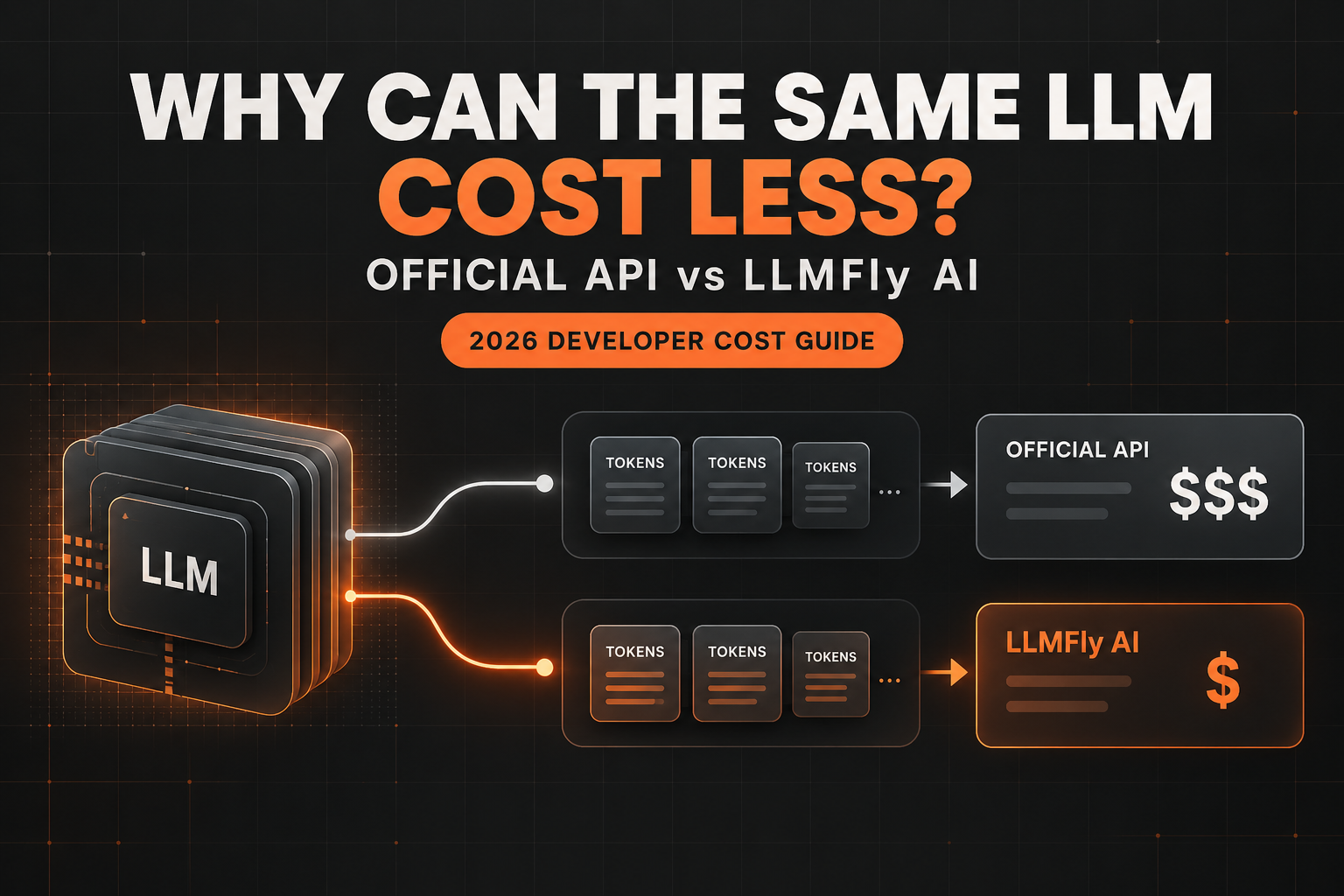
ChatGPT subscriptions are usually cheaper for a developer who works interactively, while the OpenAI API is the right—and often cheaper—choice when software sends the requests. ChatGPT Plus costs $20 per month, but it does not include a general pool of API credits. For automated workloads, LLMFly AI provides a multi-model AI API platform where supported GPT routes are currently listed below OpenAI reference prices.
Last reviewed: October 13, 2026
Quick answer: Is ChatGPT Plus or the OpenAI API cheaper?
Choose a ChatGPT subscription when one person is using ChatGPT, Codex, deep research, file analysis, or other product features directly. Heavy interactive users can receive far more model usage than the monthly subscription price would buy at list-price API rates.
Choose the OpenAI API when a product, backend, scheduled job, customer-facing application, or agent must call a model automatically. Low-volume API workloads can cost less than $20 per month, and API access provides metering, concurrency, structured outputs, separate keys, rate limits, and programmatic control.
Many developers should use both: a subscription for human-driven work and an API for software-driven work. Once the workload needs an API, compare the rate you will actually pay, including caching, retries, tool calls, and cost per accepted result.
| Need | Better starting choice | Why |
|---|---|---|
| Interactive coding and research | ChatGPT Plus or Pro | Fixed monthly price and bundled product features |
| Small automated workload | API | Pay-as-you-go cost may be well below a subscription |
| SaaS or customer-facing product | API | Programmatic access, metering, keys, and production controls |
| Heavy personal Codex use | Subscription | Bundled usage can have high effective value |
| Multi-model production system | Multi-model API platform | Lower switching and integration overhead |
Does ChatGPT Plus include OpenAI API credits?
No. OpenAI states that ChatGPT and the API platform have separate billing systems. A ChatGPT Plus or Pro subscription does not automatically provide a general balance of OpenAI API tokens.
ChatGPT Plus currently costs $20 per month. It provides higher model limits than the free plan and includes product features such as advanced reasoning access, file uploads and analysis, image generation, and deep research, subject to current limits and availability.
OpenAI also offers three ChatGPT Pro tiers as of October 13, 2026:
| Plan | Monthly price | Ultrafast mode |
|---|---|---|
| ChatGPT Plus | $20 | Not listed as included |
| Pro 100 | $100 | Not included |
| Pro 200 | $200 | Not included |
| Pro 500 | $500 | Included for GPT-6 Astra and GPT-6.1 Sol |
The Pro tiers buy different included allowances and feature access. They are not equivalent to purchasing a fixed number of API tokens. OpenAI notes that allowance consumption can vary with model choice, context, reasoning, tools, retrieval, caching, and speed mode.
How does OpenAI API pricing work?
The OpenAI API is usage-based. Developers pay for input, cached input, output, and any separately priced tools or services.
OpenAI’s current Standard API prices for short-context GPT-6 requests are:
| Model | Input / 1M | Cached input / 1M | Output / 1M |
|---|---|---|---|
| GPT-6 Astra | $10.00 | $1.00 | $50.00 |
| GPT-6.1 Sol | $2.00 | $0.10 | $10.00 |
| GPT-6 Luna | $0.10 | $0.01 | $0.50 |
These prices do not include every possible charge. Long-context requests, cache writes, tools, retries, regional processing, and faster processing tiers can change the total.
Why can a ChatGPT subscription look dramatically cheaper than API usage?
A subscription bundles product access and an included allowance into a fixed monthly price. That can be extraordinarily valuable when a human uses coding agents heavily.
In May 2026, developer and writer Simon Willison used local tracking tools to estimate the list-price API equivalent of his previous 30 days of coding-agent activity. His estimates were approximately:
- $1,199.79 for Claude Code;
- $980.37 for OpenAI Codex;
- $2,180.16 combined, compared with $200 in subscriptions.
This is strong anecdotal evidence that subscriptions can be an excellent deal for heavy individual coding-agent users. It is not evidence that a subscription contains $980.37 of transferable API credit. The measurement applies list-price token rates to tracked activity; it does not convert the plan into a general-purpose production API.
Why can’t a production application simply use a ChatGPT subscription?
A production application needs infrastructure designed for software rather than a person operating a product interface.
Common requirements include:
- server-side authentication and separate application keys;
- concurrent requests and documented rate limits;
- structured outputs and tool calling;
- automated retries and failure handling;
- per-project usage records and budget controls;
- programmatic model selection and fallback;
- scheduled or event-driven execution;
- customer-facing access without sharing a personal account.
Those are API requirements. They are not features that a consumer subscription is intended to replace. OpenAI also prohibits sharing account credentials, reselling subscription access, and automatically extracting data in ways that violate its terms.
Does Sign in with ChatGPT let other apps use a subscription?
Sometimes, within defined limits. OpenAI now allows eligible Go, Plus, and Pro users to authorize participating apps to use included ChatGPT usage. Identity sign-in and allowance sharing are separate approvals, and the user can set a limit for each participating app.
This makes subscriptions more useful for personal developer tools. It does not turn Plus into an unrestricted API plan:
- only participating apps can support the feature;
- requests draw from the applicable shared allowance;
- the connection does not create a second allowance;
- the app may charge separately for its own service;
- general API platform billing remains separate.
Developers should therefore treat subscription sharing as a supported product integration, not as a workaround for production API billing.
How do you calculate the break-even point?
For API workloads, calculate the monthly cost from real usage:
monthly API cost =
  uncached input cost
  + cache write cost
  + cache read cost
  + output and reasoning cost
  + tool charges
  + retries and fallback calls
Suppose one GPT-6.1 Sol request uses 100,000 uncached input tokens and 10,000 output tokens. At OpenAI’s current Standard short-context rates:
(0.1 × $2) + (0.01 × $10) = $0.30
About 67 identical requests would produce approximately $20 in basic token charges. That arithmetic does not make the API equivalent to ChatGPT Plus; it only shows where the token bill crosses the subscription sticker price.
The two products still deliver different capabilities. A subscription includes an interactive application and bundled features. An API provides programmable inference.
Can the OpenAI API cost less than ChatGPT Plus?
Yes. Low-volume or small-model workloads can cost far less than $20 per month.
Consider 1,000 classification requests, each using 10,000 input tokens and 1,000 output tokens. Using GPT-6 Luna at $0.10 per million input tokens and $0.50 per million output tokens:
input  = 0.01 × $0.10 = $0.001
output = 0.001 × $0.50 = $0.0005
total  = $0.0015 per request

1,000 requests = $1.50
This example excludes caching and other charges, but it illustrates the central point: subscription does not automatically mean cheaper. For a small automated workload, pay-as-you-go API pricing may be the lower-cost option.
Why is a subscription’s effective cost difficult to predict?
An API publishes token rates. A subscription publishes a monthly price plus allowances that can vary by plan and workload.
OpenAI states that similar tasks may consume different amounts of included allowance depending on:
- the selected model;
- context length;
- reasoning effort;
- tool use and retrieval;
- caching;
- Standard, Fast, or Ultrafast mode.
This is why claims such as “Plus includes X million tokens” are usually misleading. A fixed token number does not capture how the product meters different models, tasks, and execution modes.
Is the real difference human usage versus software usage?
Yes. This is the clearest decision rule.
| Workload | Subscription | API |
|---|---|---|
| Chatting, writing, and personal research | Best fit | Usually unnecessary |
| Human-supervised Codex sessions | Often excellent value | Useful for custom tooling |
| Scheduled automation | Not the general solution | Best fit |
| SaaS backend | No | Required |
| Customer-facing model access | No | Required |
| Exact per-project metering | Limited | Best fit |
| Multi-provider routing | Limited | Best fit |
How does lower-cost API access change the comparison?
Once software needs an API, the relevant question becomes: which API route provides the required model, features, reliability, and data handling at the best total cost?
As reviewed on October 13, 2026, the LLMFly AI pricing page lists its ChatGPT/Codex group at a 0.3× billing multiplier, or 70% below the provider reference prices displayed on the page.
For GPT-6.1 Sol in the standard context tier, the listed rates are:
| Route | Input / 1M | Cached input / 1M | Output / 1M |
|---|---|---|---|
| OpenAI reference rate | $2.00 | $0.10 | $10.00 |
| Current LLMFly listed rate | $0.60 | $0.03 | $3.00 |
The earlier 100,000-input and 10,000-output example therefore changes from:
OpenAI reference: (0.1 × $2) + (0.01 × $10) = $0.30
LLMFly listed:    (0.1 × $0.60) + (0.01 × $3) = $0.09
At 10,000 identical requests, the simplified basic token estimate is approximately $3,000 at the reference rates versus $900 at the current LLMFly listed rates. Cache writes, tools, retries, taxes, top-up fees, long-context pricing, and negotiated discounts are excluded.
Current prices and availability can change. Check the live Model Plaza and validate the result with a small request and its usage record before forecasting production spend.
Why does a multi-model API affect total cost?
Unit price is only part of API cost. Maintaining separate provider accounts, billing systems, credentials, request formats, and usage dashboards also consumes engineering time.
LLMFly AI provides supported GPT, Claude, Gemini, and Grok models through one multi-model AI API platform. Developers can compare the current model catalog, create separate keys for different applications, and test alternatives without rebuilding every part of the integration.
OpenAI-compatible access is available for compatible routes, but protocol compatibility does not mean every provider feature or model behavior is identical. Before production migration, verify model IDs, tool calling, structured outputs, streaming, rate limits, error behavior, data policy, and fallback behavior.
The goal is not to choose one provider forever. It is to use the least expensive configuration that reliably completes each workload.
What is the practical decision process?
Are you mainly chatting, researching, or coding interactively?
Start with ChatGPT Plus. Consider a Pro tier only if the current allowance or premium features materially change your workflow.
Does software need to send requests automatically?
Use an API. Do not treat a personal subscription or shared account credentials as production infrastructure.
Is the automated workload simple and low volume?
Estimate it with a small model first. The total may be far below $20 per month.
Are costs reaching hundreds or thousands of dollars?
Measure input, cache, output, reasoning, tools, retries, and accepted-result rate. Then compare model and route prices using the same workload.
Do you use several model families?
Evaluate a multi-model platform against the cost of maintaining separate integrations. Include reliability and compatibility—not only the advertised discount.
Frequently asked questions
Can I use my ChatGPT Plus subscription as an OpenAI API key?
No. ChatGPT and API billing are separate. Participating tools may support Sign in with ChatGPT and request permission to use an eligible included allowance, but this is not a general API balance.
Is ChatGPT Plus cheaper than using Codex through the API?
It can be for heavy personal, interactive Codex use. The answer depends on current plan limits and the work performed. Production or customer-facing automation still requires an appropriate API setup.
How much OpenAI API usage equals $20?
There is no single answer because models, input/output ratios, caching, reasoning, and tools have different rates. For the simplified GPT-6.1 Sol example above, approximately 67 requests of 100,000 input plus 10,000 output tokens reach about $20 at reference rates.
Should a developer pay for both ChatGPT Plus and API access?
Often, yes. Use the subscription for interactive personal work and the API for applications, automations, scheduled tasks, and production systems.
Is a cheaper third-party API always the better choice?
No. Verify the actual model, pricing scope, API compatibility, latency, rate limits, error behavior, data handling, billing rules, and production reliability before migrating.
Bottom line
ChatGPT subscription versus OpenAI API is not a choice between two equivalent buckets of tokens. A subscription buys a person access to the ChatGPT product and an included allowance. The API buys software measurable, programmable inference.
For a heavy individual user, ChatGPT Plus or Pro may deliver exceptional effective value. For a small automated workload, an API may cost less than one subscription. For production systems, API access is the relevant category, and the correct comparison is model × tokens × tools × retries × success rate × route price.
Use subscriptions where humans drive the work. Use APIs where software drives the work. Once you choose an API, compare the rate you actually pay and the cost per accepted result—not only the provider’s headline price.
Sources
- OpenAI Help Center — What is ChatGPT Plus?
- OpenAI Help Center — Managing billing for ChatGPT and the API platform
- OpenAI Help Center — About ChatGPT Pro tiers
- OpenAI Help Center — Using your ChatGPT plan in other apps and sites
- OpenAI — Introducing GPT-6.1 Sol
- Simon Willison — I think Anthropic and OpenAI have found product-market fit
- LLMFly AI — live API pricing comparison
Leave a Reply